From Shildon to Rangoon and back
Timeline
Bill wrote as the memories came back to him rather than in order, and he dated very little. This page sets out what can be dated, and links each entry to the chapter that tells it.
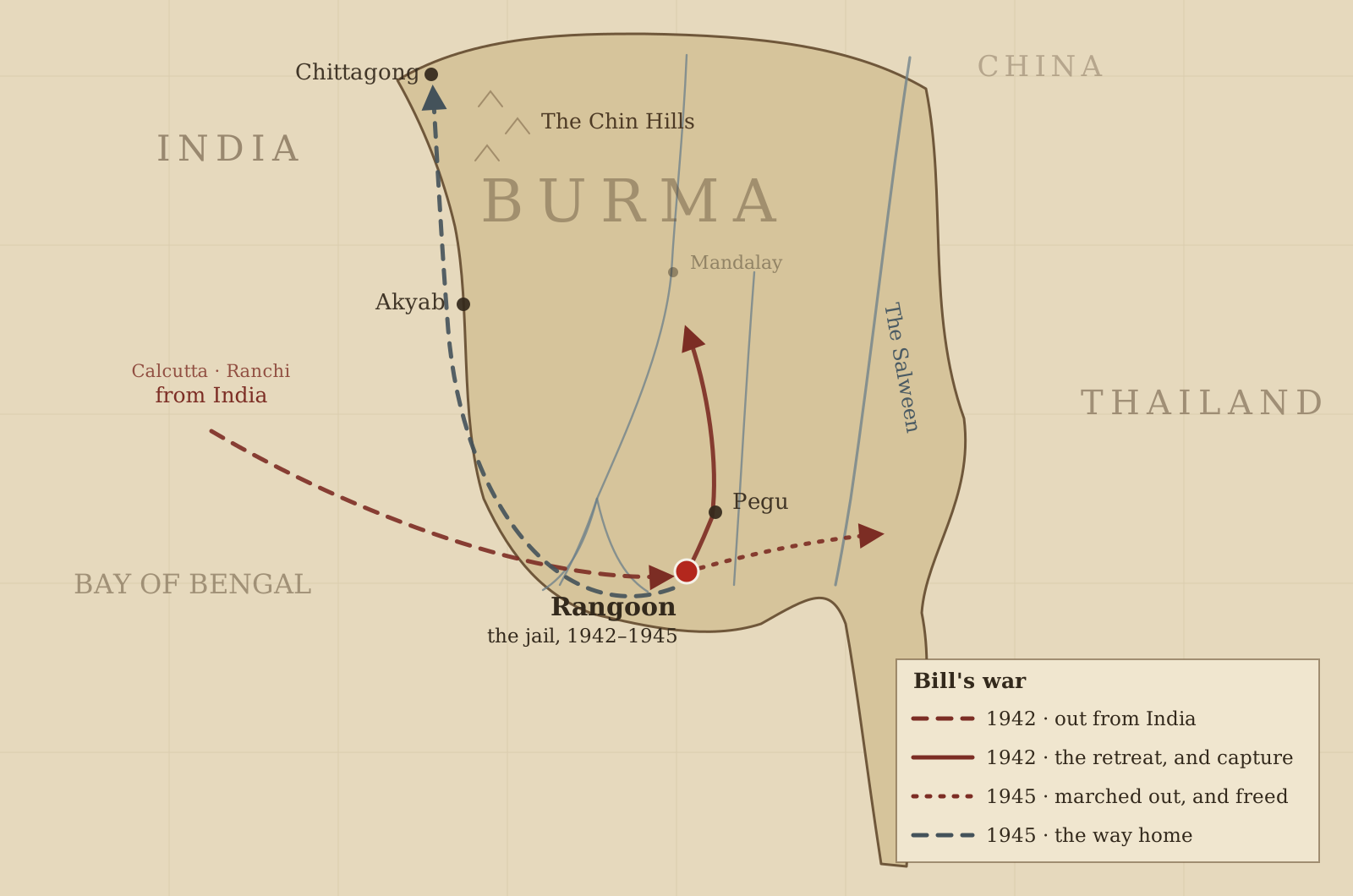
Entries marked the wider war are not from Bill's account. They are added for context and are drawn from published histories of the Burma campaign. Where accounts differ on a date, that is said.
-
29 September 1918
Born in Shildon, County Durham. Tom Raine, born in the same town, is his friend from the beginning and will one day be his best man.
Read this chapter → -
At seventeen
Both fathers, railwaymen, are transferred to York, and the two boys move with them.
Read this chapter → -
Late summer 1939
Bill and Tom sit on a fairground ride, killing time until two o'clock, when they are to register for the Militia at the Employment Office. The pay is a shilling a day, out of which they must buy their own polish and Brasso.
Read this chapter → -
3 September 1939the wider war
Britain declares war on Germany.
-
15 September 1939
Called up, twelve days after the declaration. Training begins at Fulford Barracks in York, and the pay is raised to two shillings.
Read this chapter → -
Winter 1939
After about ten weeks, on draft to India to join the 1st Battalion, The West Yorkshire Regiment.
Read this chapter → -
1940–41
Two years in India.
Read this chapter → -
14 December 1941the wider war
Japanese forces enter Burma. The campaign begins.
-
Early 1942
Sent from India to Burma to reinforce the regiments already there.
Read this chapter → -
7 March 1942the wider war
The British evacuate Rangoon.
-
Spring 1942
Outnumbered and overrun, the battalion falls back. A sergeant is detailed to blow the bridge over the Salween, sees his own brother on the far bank, and blows it anyway.
Read this chapter → -
Spring 1942
Deserted by their officer and left without maps or money, they reach a river many of them cannot swim, and are surrounded and taken prisoner.
Read this chapter → -
12 March 1942
Bill was posted missing by the British Army on the same date his Japanese POW record gives for his capture. The exact place and circumstances remain unknown. He was later registered at Rangoon Jail as prisoner VI 71.
Records: FEPOW Family record · Rangoon Jail roll
-
1942
Marched to Rangoon Jail — the “Big House”. Searched at the gates, where the guards take their knives, forks and the needles from their housewives as possible weapons. Bill recalls being held in No. 3 block, about thirty men in a cell built for twenty; a camp report independently identifies Block 3 as the British block.
Read this chapter →Records: Layout and description (AIR 40/1855)
-
May 1942the wider war
The British retreat into India is completed, just before the monsoon breaks.
-
1942–1945
More than three years in the jail: working parties loading ships, re-treading tyres and lifting unexploded bombs; roll call twice a day; no mail either way.
Read this chapter → -
Late April 1945
The men judged fit are marched out of the jail towards Pegu, hand-carts and all, and learn on the road that they are bound for Thailand to work as coolies. Allied aircraft are overhead often, and the roads are being mined.
Read this chapter → -
25 April 1945
Bill was among the prisoners marched out of Rangoon Central Jail at about 4 p.m. on 25 April. One 1946 group report counts 441 Allied prisoners; a separate selective interrogation report says just under 400 left. Both describe the party, not a Bill-specific diary. The route account follows the main road past Ledaunggan and Pegu, then north-east by the railway towards Waw.
Read this chapter →Records: Rangoon Jail report (1946) · Naung Pattaya march account · West Yorkshire POW list
-
29 April 1945
Bill’s Rangoon Jail record confirms his liberation at Naung Pattaya Railway Station. His memoir recalls that the men were met by African paratroopers and handed to the 1st West Yorkshires; that detail remains his recollection rather than independently verified here.
Read this chapter →Records: Rangoon Jail roll · Rangoon Jail report (1946)
-
29 April 1945the wider war
At Rangoon Jail, prisoners who had been left behind heard the Japanese guards leave that evening. They secured the prison and, with members of the Indian National Army, kept order until Allied troops arrived. This is the account of those who remained in Rangoon, not Bill’s experience on the march.
Records: Liberation of Rangoon Jail report
-
1 May 1945
A second War Office form: no longer missing, reported in Allied hands. It is the first word his family has had that he is alive.
-
Early May 1945the wider war
Allied troops retake Rangoon. Prisoners left in the jail paint “JAPS GONE” on the roof, adding the RAF slang “EXTRACT DIGIT” to show the message came from British hands. Accounts differ by a day or two over when it was seen and when the jail was reached.
-
1945
Home by way of Akyab and India.
Read this chapter → -
1945
Treated at York Military Hospital. Strongyloides is diagnosed there but not passed on to his doctor, and goes untreated for decades.
Read this chapter → -
September 1945
A welcome-home letter from King George VI: “The Queen and I bid you a very warm welcome home.”
Read this chapter → -
13 September 1945the wider war
Japanese forces in Burma formally surrender, at Rangoon.
-
After the war
At a christening in the local church he finds his own name on the Roll of Honour, among the dead. The family have it erased.
Read this chapter → -
2 October 2008
Bill, just ninety, appears in the Keighley News holding the printed book. He wrote it at his doctor's suggestion, most of it while staying at a Combat Stress home, and gave the proceeds to the charity.
Sources and further reading
These records and collections helped establish the dates above. Bill-specific records are grouped separately from broader historical context and research leads.
Bill’s records and unit
- FEPOW Family — William Troughton’s recordService number, rank, 12 March 1942 capture date and Japanese index-card reference WO 345/52.
- Roll of Honour — Bill’s Rangoon Jail entryPOW number VI 71 and liberation at Naung Pattaya on 29 April 1945.
- COFEPOW — 1st Battalion West Yorkshire RegimentLists Bill among the men taken on the march from Rangoon.
Rangoon Jail and the final march
- Rangoon Jail report (31 July 1946)A postwar investigation describing the prison and the group march in April 1945.
- Liberation at Naung PattayaA selective group account of the march via Pegu and Waw, arrival on 29 April, release, and evacuation.
- Liberation of Rangoon JailAn account by prisoners left behind, including how they secured the jail after the Japanese guards withdrew.
- Layout, description and conditionsCamp-level details identify Block 3 as British; individual circumstances should still be attributed to Bill’s own account.
- Full British Roll — Rangoon JailAlphabetical roll compiled from archival lists. The site states its material is not public domain and requires permission for reuse; this site links to it rather than reproducing the roll.
- Rangoon Jail databaseStarting point for comparing prisoners’ records.
- Alfred Bell — Rangoon Jail entryVI 70, captured on 12 March 1942 and liberated at Naung Pattaya.
- Raymond Dowd — Rangoon Jail entryVI 69, also recorded as captured on 12 March 1942; he remained in Rangoon.
Campaign, eyewitness accounts and memorials
- Burma Star Memorial Fund — West Yorkshire RegimentBackground on the battalion’s Burma campaign.
- Chindit Chasing — Operation LongclothSpecialist secondary research on Rangoon prisoners and the march; useful leads should be corroborated.
- Pegasus Archive — Prisoners of WarFirst-hand POW accounts and related material.
- Australian War Memorial — Rangoon Jail, 2 May 1945May 1945 photograph of the jail with messages painted on its roof.
- Commonwealth War Graves CommissionSearch graves and memorial records, including Yangon and Taukkyan.