Chapter Fifteen
Liberation
After more than three years in Rangoon Jail we were brought out one day to load hand-carts with rice and sundries and leave them by the gate. The next morning all the men judged fit were marched out, taking the carts with us, towards Pegu — back towards the country where we had been taken in the first place. We had been issued with Japanese boots before we set off, but I, like many others, soon threw mine away; after so long barefoot we simply could not wear them.
On the second day our own fighters came down on us, and we scrambled off the road into the trees. I dived into a hedge, and when the planes had gone I came out with blood streaming down my forehead; everyone thought I had been hit, but I had only chosen a bramble bush. After that the Japanese moved us by night and lay up by day. We learned now that they meant to take us on into Thailand, to work as coolies. But the roads were being mined, and our aircraft were over us often, and we understood from both that our own forces could not be far off.
We halted for the day in a large clearing ringed with trees and hedges, hungry, having had nothing to eat for two or three days. The Japanese posted armed guards and then called a meeting, the Brigadier who had commanded us through the jail among them. I overheard two sub-conductors — one an Anglo-Burmese, one an Indian — talking of making a break for the Chin Hills, and asked to join them, and was taken in. But it never came to that, for the Brigadier came back to tell us the Japanese had simply gone, knowing they had no hope of getting clear with us in tow.
Some RAF men went round collecting anything red, white or blue, and in the next field laid out a message marking us as ex-prisoners of war, and ringed it to warn the aircraft off. The reply was a swoop with guns blazing; happily they were poor marksmen, and no one was hit. Then, taken for Japanese still, we were bombed and shelled by fighter-bombers. A line of us lay down behind a very big tree, and I, being last of the ten, thought a bomb crater would be safer and set off to reach one, going to ground in a hedge as the machine-gunning came in, certain each round had just missed me. When it was over, the only man killed was the Brigadier — a bitter thing, after all the years he had done his best for us.
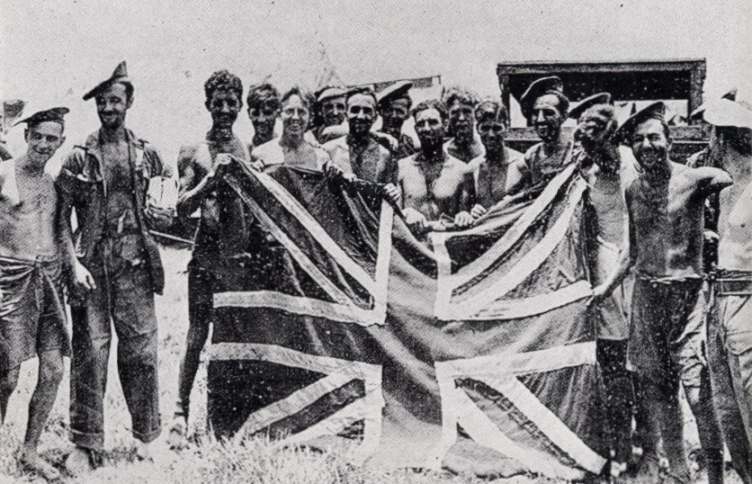
We scattered. Half a dozen of us reached a native village and were taken into a house on stilts and given welcome food; soon a Burmese came in to warn us to keep quiet, for there were Japanese in the space beneath. The Burmese had changed entirely towards us — they had had enough of the Japanese, and were on our side now. Before long a British ex-prisoner came to say that an American officer had made contact with our troops, and that we were to meet paratroops a mile off. We set out in the half-dark and met them as night fell — big African paratroopers. There is no describing what we felt. They put us aboard open lorries and we drove off, passing a field where Japanese lay dead to the last man behind their machine guns.
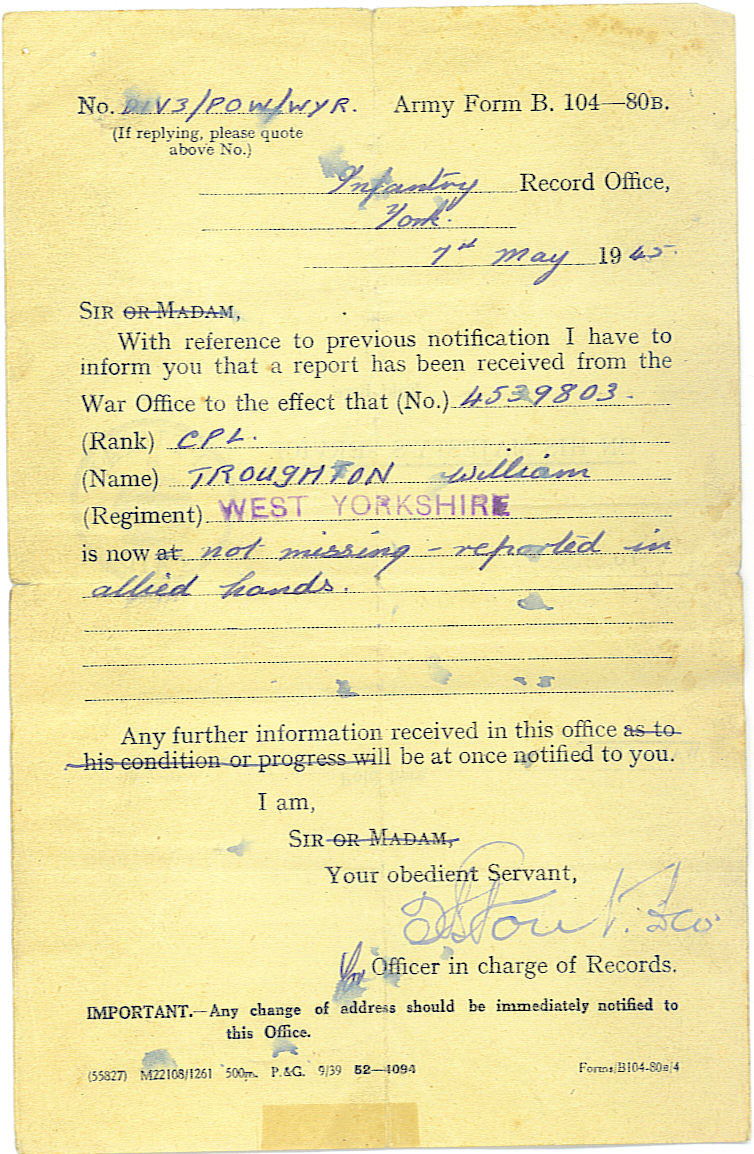
We were freed on the 29th of April 1945, the day before my father's birthday. The cook of the West Yorkshire Regiment brewed Indian tea laced with whisky — a very welcome drink — and, short of decent clothing as we were, the men of the battalion gave us some of their own kit to cover us. Later I met one of those young soldiers again, and he told me the regiment had charged them for the replacement of it.
For it was our own battalion, the 1st West Yorkshires, to whom the African paras handed us. Their Regimental Sergeant Major had once been Sergeant Major of one of the companies, and when he saw one of his old company standing there in nothing but a worn pair of shorts, ribs showing, wasted like the rest of us, he took the man into his arms and wept. Soon after, a sergeant reported that they had wounded a Japanese sniper who was dying slowly, and asked what to do with him. "After what I have seen," said the RSM, "let the beggar die slowly."
Contents · Switch to Bill's manuscript