Chapter Nine
No Good San
Much of jail life turned on the guards, and on learning their moods. The man in charge of the Garden Party was named Noguichi-San, which we soon converted to No Good San. He would march us out to the garden, halt us, and dismiss us with a flourishing salute that we were obliged to return — and for that salute, among other things, he was also known as the Admiral. His manner was a comedy, though the man himself was no joke. One day I fell out of the ranks to light a cigarette with the sun and a magnifying glass; his shout of Nan da kurra! should have warned me, but before I could move he caught up a garden rake and brought it down on my head. I felt it.
Another time I was sent to do a tobacco errand for one of the officers, through Noguichi. We used the Burmese cheroots, broken up, to make cigarettes; the other local smoke was little more than chopped bamboo and no use to us. Noguichi brought the wrong sort, and when I tried to tell him so he aimed a kick at my groin. I turned aside, slipped a hand under his foot, and sat him down hard on his behind — then made myself scarce, and for some reason he never found me.
Punishments were handed out on a whim. The Admiral would decide that two men deserved it and set them facing each other to slap one another's faces; more often than not one would only pretend to slap while the other clapped his own hands together, and the pair of them got away with it. The whole Japanese system ran on it: a man was punished for anything a superior judged wrong, and rank was marked by stars — a red cloth oblong for the recruit, then a yellow star, a second, a third, a silver star, and so on up. We were at the very bottom of that ladder, and so had no chance at all.
Twice a day we stood for Tenko, the roll-call, numbering off in Japanese, which we learned soon enough. One day a Scottish regiment was counting, and when it came to seven — hichi — the Scot rendered it hechi, the nearest his tongue would go. The guard exploded, screamed bugaro at him and knocked him about; and when the same thing happened the next day, an Englishman was quietly drafted into the number-seven spot to spare them all.
There was a fine pantomime, too, the day an Irish Sergeant Major was given leave to drill his men, on condition the commands were in Japanese. I stayed to watch, certain it would be no ordinary parade, and I was not disappointed. His brogue was such that I could not follow his English, let alone his Japanese, and I doubt the squad could either. For the first minute all went well, the men marching smartly away from him — and then came his command to about-turn. The result was as if a bomb had dropped in the middle of the squad, a hole blown clean through the centre and the men marching off in four directions at once.
Hygiene was a watchword, at least in theory. Nogger, the chap who boiled our water — a task absolutely vital in that place — was a man of limited wits but perfectly suited to it. The Medical Officer caught a man dipping his can straight into the tank and admonished Nogger: this must not be allowed, we must think of hygiene at all times. When the next man came to dip his can, Nogger moved in, stopped him, and announced: "You are not allowed to do that. The Doctor has told me there has been an outbreak of hygiene, and we have to do everything to stop it."
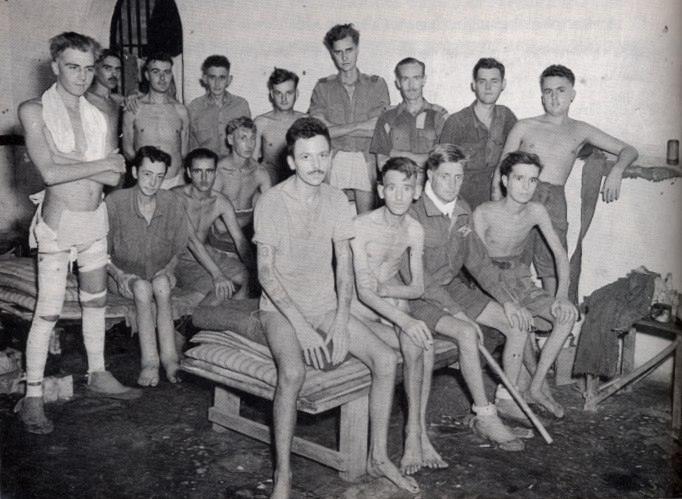
The latrines were a long open building with rows of stone blocks and a munitions tin between each pair, emptied each day into fifty-gallon drums. Two men unfit for the working parties carried each drum slung from a bamboo pole on their shoulders, the man behind getting the worst of it as the liquid swirled and slopped. Solid stools were unheard of, until the day a chap came running out swearing that someone had produced one that stood up for itself. He was not believed until two more had gone in and confirmed it, whereupon most of the compound filed past and saluted the thing. An RAF officer finally owned up to being the cause, though he could not say how. The drums were emptied into a cement-lined pool that soon heaved with maggots and then with flies, which descended on the compound in clouds and settled on every dish, so that we ate with one hand forever passing over the food. On Sundays the Japanese would come with little bottles and fly-swats and make us fill the bottles with the flies we had killed.
Every Sunday, too, a few of us met under a big tree in the back compound, where an officer taught us Urdu. One by one the others dropped away until only he and I were left, and then one Sunday he sent word that he was ill and would not be coming, so there was no point in my attending. That illness saved my life. There was an air-raid, and our own aircraft came over with a mixed load of bombs. The first blew up a small cookhouse but left three men eight yards off untouched; I was in the passage of the building and went straight to the ground, and when I rose I could not see a yard for the whitewash hanging in the air. The next bomb demolished our tree — where, but for his illness, the two of us would have been sitting.
On another day I was coming back from the latrine, weak with dysentery, when the bombers came over. Halfway to the trench I heard the bombs whistling down; I dived in, and a brick struck the side just above my head. The same bomb fell on a slit trench and buried the men sheltering in it.
Even our captors went in for entertainment. They held a brass-band concert that we were all ordered to attend and to applaud after each piece, bored stiff as we were. One tune was catchy enough that a prisoner set our own words to it, which we sang on the march; the Japanese were quite pleased, and would have been a good deal less so had they understood what we were singing.
Contents · Switch to Bill's manuscript