Surviving the Red Chapatti
Bill's Manuscript — complete
Bill's account exactly as he wrote it — his own words, in his own order.
The whole account on one page, for reading straight through, printing, or saving.
- Chapter One
- Chapter Two
- Chapter Three
- Chapter Four
- Chapter Five
- Chapter Six
- Chapter Seven
- Chapter Eight
- Chapter One
- Chapter Two
- Chapter Three
- Chapter Four
- Part Three
Part One
Chapter One
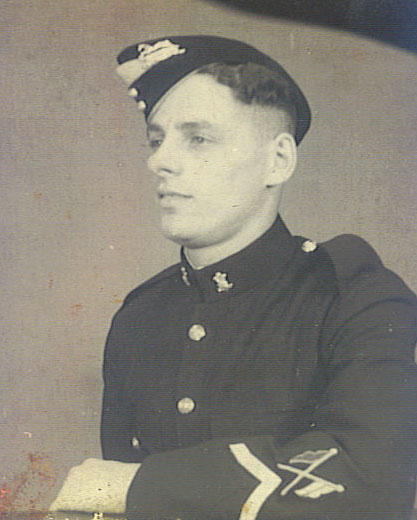
I was born on the 29th September 1918 in the town of Shildon in County Durham. Tom Raine was also born there and we were great friends. We went to school together and spent our free time together also. Our fathers both worked for the railway and were both transferred to York when we were seventeen years old. We were able to remain friends after the move.
Tom and I met in the fairground and sat on one of the rides waiting for 2 o'clock to register for the Militia at the Employment Office. We were to serve in the forces for six months followed by three and a half years in the Reserves. Pay would be one shilling per day, out of which we would have to purchase certain items of cleaning materials such as shoe polish, brasso etc. This amount was raised to one shilling and sixpence per day after the intervention of the mothers whose sons were being called up. As it happened the war commenced a couple of weeks before the call-up on 15th September and we were paid two shillings per day.
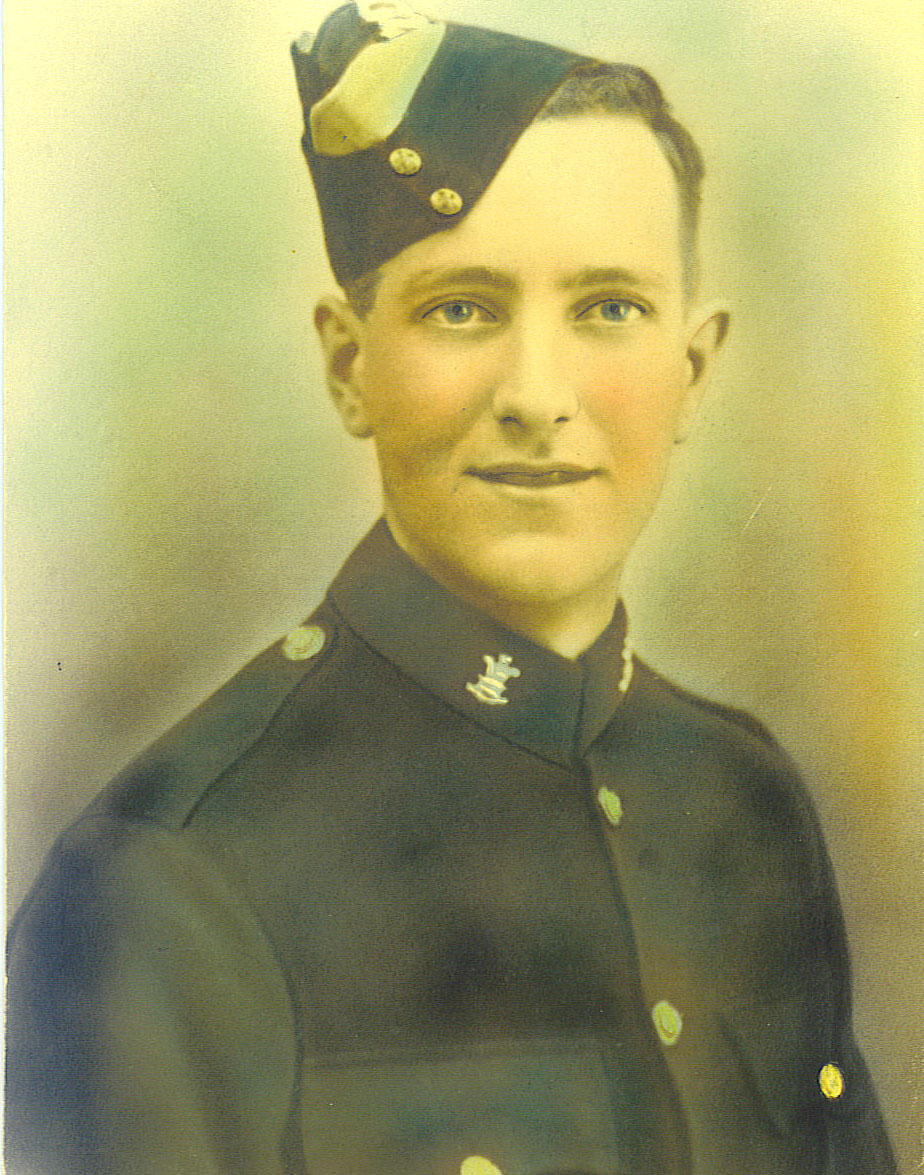
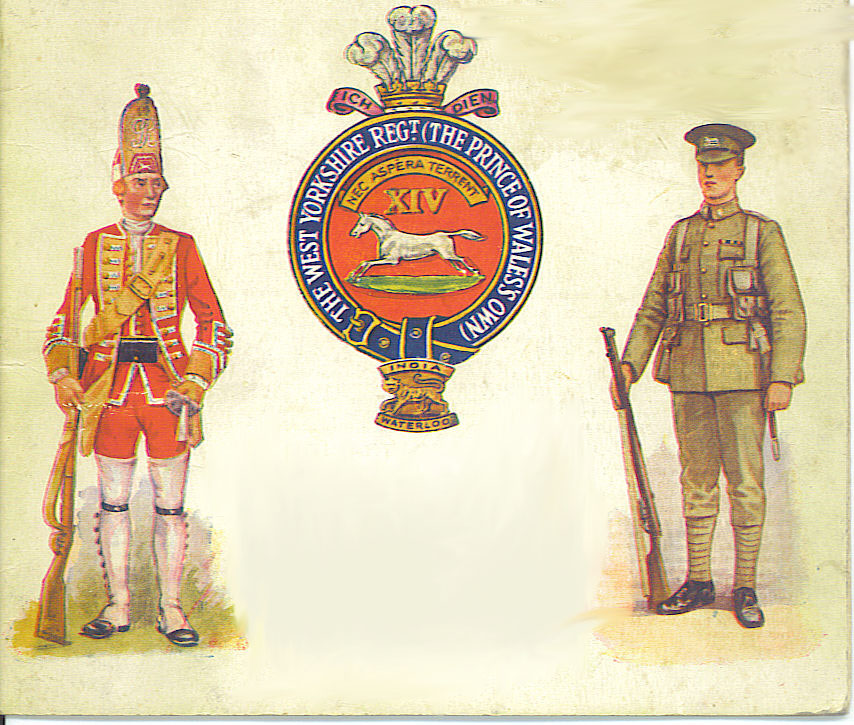
Both of us started our training at the Fulford Barracks in York and after about ten weeks were on draft to India to join the West Yorkshire Regiment. After two years we were on our way to Burma to re-enforce the regiments already there. We were out-numbered and over-run and in a matter of weeks were in retreat and eventually captured by the Japs. Having been informed that Rangoon would be held at all costs we were making our way there when we were told that the Japs had landed in Rangoon and taken over the city. We then decided to make our way north to get out of Burma.
When we received the order to march to Rangoon, one of our sergeants was detailed off to blow the bridge over the Salween River, the route that the Japs had to take to get into Burma. The sergeant looking across the bridge saw his brother at the other side but he still had to blow the bridge which meant leaving his brother to the mercy of the Japs who were just behind.
Unfortunately, we had been deserted by our officer, leaving us without maps and cash to aid our escape. We ended up at a river with a lot of us unable to swim, and then surrounded by Japs and captured. The officer who deserted us was court-martialled after he had used the company cash to hire a boat to get to India.
Normally the troops complained about the emergency ration of corned beef. We, however, got emergency rations of pilchards but the oil in which they were contained almost boiled in the heat of the sun. They were not at all palatable.
Part One
Chapter Two
We were taken prisoner and marched to a large house some miles towards Rangoon and allocated spaces for sleeping with a restricted area for daytime use. After about two days, a small party of men, including Tom, was sent into Rangoon for rations of rice and dried potatoes. A couple of men were given the job of cooks, of which they claimed they had experience. The only utensil they had was a metal bath tin which they filled with rice and water and placed over the open fire to boil. The amount of water used was at best about a quarter of what was necessary and the result was a mass of burnt, uncooked rice to be consumed over the next three or four days.
After a few days we were told we were to go to a big house in Rangoon and we set off in the march there. Eventually we were passing the prison which Tom informed everyone was now a ration store which we would pass to get to the "Big House". He was totally wrong as the "Big House" was actually the prison where we halted outside the gates, were searched and moved inside. There we halted, emptied out our pockets and whatever containers we had for the Japs to appropriate any items they thought we should not have. These included knives, forks and needles from our "Housewives" all of which they said could be used as weapons.
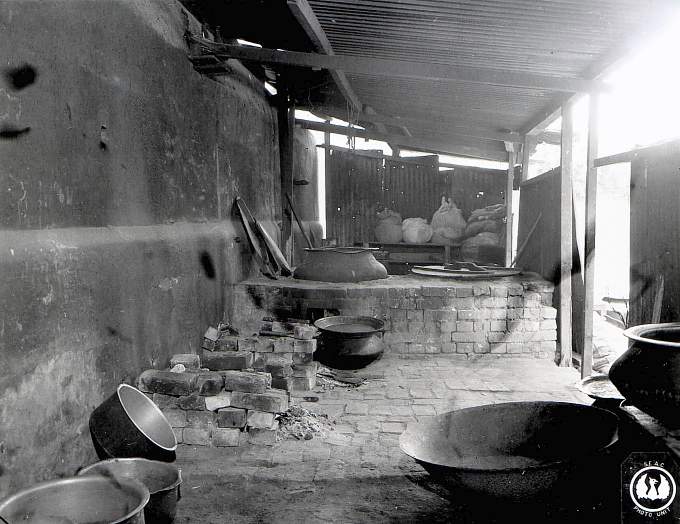
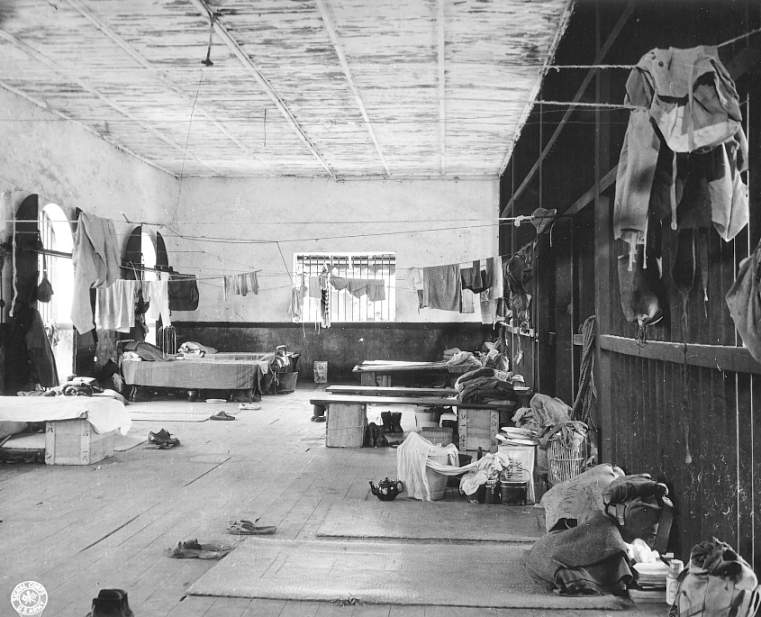
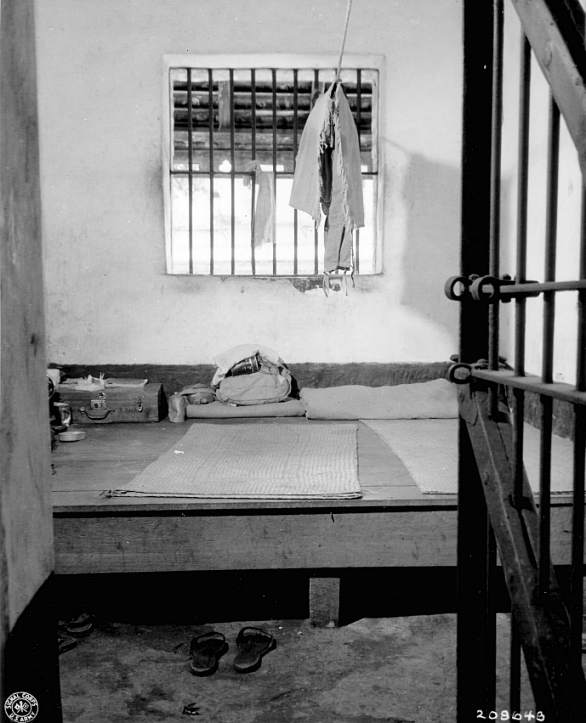
The cells were made to accommodate twenty civilian prisoners in blocks of five cells with six blocks stemming from a hub which was a water tower. We were marched to No. 3 block which we entered and found playing cards scattered all over the floors. We gathered them up willy-nilly to sort them into packs later. These were our only source of entertainment for quite a time as we were confined to the cell, about thirty plus instead of twenty as intended. Some had a wooden slatted bed with a wooden pillow, others slept on the floor. The beds were riddled with bugs so I don't know who was better off. The beds were fixed in the floor but eventually we freed them so we could move them out into the sun, which caused the bugs to leave the beds to try to get back to the buildings, usually to perish on the way. Time passed slowly with nothing to fill the hours except for playing cards in groups and sharing a cigarette made by rolling cheroot tobacco in newspaper or whatever paper we could obtain.
The Japanese flag used to be a red semi-circle with rays on a white background. This was changed to a full red circle on a white background without the rays. These we named the red chapatti. We did this as an insult to the Japanese, and the nickname is also that for this book.
Part One
Chapter Three
In these early days one of our good friends, Laurie Scarborough, became ill, diagnosed by the Japs as suffering from TB. This scared them so they moved him and four of us into isolation in an adjoining cell, where, after a week or so, Laurie passed away. We had to take him out of the jail to a field where a trench had been dug, filled with bamboo and a metal grille placed on top with his body on that. The lot was soused with petrol and set alight. It was not burning fast enough so we were made to get bamboo poles to keep turning the body to speed up the decomposition. This has caused me to have nightmares over many years, and no doubt did the same to the rest of the party.
One day the Japs came to the compound with some squares of white cloth with Japanese script round the edges and a large central Japanese number in the centre. These were to sew onto our shorts for identification. The difficulty was deciding which way up they should go. I had a good laugh at their quandary because my number, eleven, was unmistakable as follows: 11. I got a shock when a Jap came up and belted me, calling me stupid (bugaro). The Jap eleven is actually (=).
We did not have a doctor with us but decided we ought to have something akin to a medical room but the only person with any medical experience was a sergeant named Smeraldo, of Italian descent. He changed his name to Esmerald, being afraid of the Japs' reaction to him being on the opposite side to their allies. He refused to have anything to do with a sick bay or anything like it.
A tank crew was brought in to the camp one day, one of whom had a broken ankle which we attempted to set, totally incorrectly, and his foot was set at about ninety degrees from where it should have been. He was lame for the three years of his captivity, though, no doubt, the leg could be re-set when he got home. His leg had been broken when he had jumped from the tank which had had a Molotov cocktail thrown into it. His wound was full of maggots; we took them out, leaving just a few of them to clean out the wound.
Part One
Chapter Four
We were moved from 3 Block to No. 6 which was to be our abode for the next three years — though we never gave up hope that we would be out by Christmas. We were informed that we would shortly be going out on working parties; we looked forward to this as life confined to the cell had become very boring and any change would be welcome.
One of the first jobs we got was to remove all the sandbags that had been put up round all the doors and windows at the front of the jail. Much later a working party was marching towards the exit to the jail when aircraft appeared above. The Japs were changing guard at the time in the archway leading out of the front of the jail. An aircraft was hit and our party flung themselves to the ground, at which the Japs began to laugh, but not for long because the bombs we had heard on the way down exploded outside the entry to the jail and decimated the lot, leaving us on the ground untouched.
One day we saw a number of British prisoners brought in to our old Block No. 3; they had several weeks' growth of whiskers and hair and many of them appeared to be quite ill. By this time a Medical Officer of high rank had arrived in our block and another doctor came into 3 Block, so things appeared to be looking up. However we still had no medical supplies.
I had now developed a large swelling on my neck which restricted movement of my adam's apple and consequently I was unable to move my head freely or to swallow food as normal. This persisted for five or six weeks until finally, in desperation, I plunged the sharp end of a pair of tweezers into the swelling and gained some relief when a large amount of pus was released. From this day for a few days I applied poultices of hot rice, releasing large amounts of pus each day.
I was also at this time suffering with dysentery, as were many others, including a good friend of mine, Harry. The only treatment was starvation, usually for ten days or so, then a diet of rice water followed by a small amount of rice after about a week. At night Harry and I had to get up to the toilets at the far end of the block going down the passage in absolute darkness. We often passed each other, both of us saying "Coming out right" or "Coming in right" as a warning against bumping into each other. At this time we both lost about six stones in weight, which we did not recover during the remainder of our time in the jail.
We continued to go out on working parties and about thirty of us went to a local school where we were divided into two parties, one of which I took charge of and stayed at the school, the others going with a Sergeant Major to work in the town. Civilian Japs took charge of both groups. Before returning to the jail the other group re-joined us and the Sergeant Major asked how we had fared and told me that their civilian Jap had taken them to a café for a sit-down meal. I did not hold back in telling him what I thought about our lot who had left us all day with nothing to eat or drink. I did not notice the civilian Jap nearby listening in, obviously English-speaking, understanding all I had said as he came to our Sergeant Major and requested the same party for the following day.
When the party assembled the next day it was noted that a second Sergeant Major had joined the party, his first and only venture outside the jail, no doubt because he had been told of the meal some of us had had. The following day the whole party stayed at the school and we all had a fabulous meal of curried beef and rice, no doubt because of my tirade the previous day.
We set out one day and ended up at the docks, no more than a mile or so from the jail. We were unloading a ship, much of the cargo being comforts for the Jap troops. Most of these were small bags containing items more suitable for small children e.g. Yo-Yo's, whistles etc. One of our chaps opened a bag and found a small tin of tomatoes in it which set everybody on opening and searching the bags, but with very little luck. The opened bags were dumped in the dock, surprisingly unnoticed by the Japs despite the large numbers floating around the ship. One of the chaps came up to me to tell me that there was a large box as used for console radios round the corner with the lid somewhat loose because of missing nails. On investigation I found that it was just possible to prise open the lid sufficiently to extract a packet of cigarettes, which I commenced to do. I had just extracted a packet when there was a bellow behind me from a Jap officer who had pussy-footed up. Without moving I flicked the cigs away into a pile of rubbish in the corner. The officer suspected but had not actually seen this and accepted my story that I had been examining the part-nailed lid which I said should be nailed up. His reaction was to call one of his men to get the box transported away. The Jap collared me and a couple more to put the box on to a lorry then we got on with a couple of Japs and off we went.
A short while after came the noise of an aircraft in the distance which we assured the Japs was English. Both of them at once continued to look at the aircraft and while they were so engaged the three of us took out several packets of cigarettes. I concealed four packets, one each side of each ankle with a puttee round each. Later we were lined up for the usual search and when the Jap got to me I pulled some paper from my pocket, said it was to make cigarettes if I could have it. As expected it was refused and I was bashed, but he passed on without searching. The following day we returned to the docks and were generally clearing the area when I spotted a tablet of soap, ingrained with grit but better than nothing, so I picked it up and pocketed it. The Jap sergeant in charge came up and gave me a rollicking and a couple of hefty slaps. He spoke good English and told me that I had no need to take this as we got plenty of soap and cigarettes in the jail. I took the opportunity to deny this and got quite vehement about it, not knowing what punishment to expect. I got quite a surprise when he believed me, went away and came back with a packet of cigarettes to hand round to the lads.
We had another spell on the docks which lasted three days and nights, loading lead ingots, lifted on to a shoulder by two of the lads and taken on to the ship, on to a plank to the open hold and dumped. This went on for twelve hours per shift over the three days for each of the two squads. A job well done, but not as good as the Air Force who came over the day after when the ship had moved out to the middle of the river, dropped bombs on it and down it went, as could be expected with the load it carried.
Another spell on the docks was again of twelve-hour shifts, working on a coal barge, emptying the hold by shoveling the coal into a ten foot tall bucket-shaped container which, when full, was hoisted up and out of the ship. We had no foot gear at this time and had to shovel the coal into the container standing on the coal in the barge. Not very comfortable, especially at the end of the hour-long spell when the next shift came on. When we came off the ship for an hour's rest we were covered in coal-dust, but not for long as we sweated (rather than perspired) and the lot was removed. We were rewarded with a rice-ball at midnight.
Part One
Chapter Five
In the jail, life went on as usual but, thanks to one of the officers, we started to get spinach with our rice at tea-time. He had spotted this growing wild and started cultivating it, saving the seed and not eating any during the first season. Eventually the amount grown virtually covered a large field outside the jail. We also grew sweet potatoes, nothing like anything I had ever grown before. A cutting inserted in the ground took root and then traveled along, now and again sending out shoots which rooted and then grew a sweet potato just under the soil. We used to scratch away the soil, find a sweet potato, carefully break it off and return the shoot to its place in the soil leaving it looking undisturbed. The young potato was eaten raw and was a treat, nothing like the mature ones.
The Jap in charge of the Garden Party was named Noguichi-San which we converted to No Good San. He would march us to the garden, halt us, and then dismiss us with a salute which we had to return. One day I fell out of the ranks and was lighting a cigarette with the sun's rays and a magnifying glass. His shout of NAN DA CURRAII should have put me on my guard but he picked up a garden rake and bashed me on the head — I felt it!!
The officers were being paid but most of it being deducted for board and food. However they still had some money left which they used to buy cigars or rather Burmese cheroots and some food. Usually they would ask one of the men to do the transaction for them through Noguichi, and one day I was to do this for one of them. We used the Burma cheroots to break up and make cigarettes but the other Burmese smoke consisted of very little tobacco mixed up with chopped-up bamboo. These were no good to us as they were no use to make cigarettes. Noguichi came and brought the wrong type of smokes. I tried to tell him they were the wrong ones and he reacted by trying to kick me in the genitals. I turned aside a little, put my hand under his foot and he landed on his behind on the ground. I disappeared and for some reason he did not find me.
Because of his pretentious way of saluting on dismissal he was also known as the "Admiral" but his mannerisms were most amusing though many aspects of the man were not. Occasionally he would decide that the actions or deeds of a man or men warranted punishment and he would make them stand facing each other and commence to slap each other. Usually one would appear to slap while the other clapped his hands together and very often got away with it.
Back in camp life went on; one of the cells had an Irish Sergeant Major in charge, the men being from different areas and regiments. The Sergeant Major was given permission to exercise the men by a drill parade providing he gave the commands in Japanese. I decided this was going to be no ordinary drill parade and stayed to look on. His brogue was such that I could not understand his English at all and I don't think I was alone in this. However for the first few minutes things were going quite well with the squad at the time marching away from him. Surely it could not last. His command came in Japanese to 'about turn'. The result was catastrophic; it looked as if a bomb had dropped right in the centre of the squad with a large hole in the centre and the squad marching in four different directions.
Nogger was the chap in charge of the boiling of water, absolutely necessary in this environment. He was of limited intelligence but certainly efficient for his task. He was in the hut where his large drum was kept when one of the men came in, dipped his can in the tank and left. The Medical Officer (M.O.) was passing at the time and went up to Nogger to admonish him for allowing the man to dip his can into the water. "You should not allow this to happen, it is not hygienic and we must think about hygiene all the time." When the next man came and attempted to dip his can in the water Nogger moved in on him, stopped him and said "You are not allowed to do that. The Doctor has told me there has been an outbreak of hygiene, and we have to do everything to stop it."
We were given a task in the jail to do a bit of patching up using the Japs' idea of mortar, mixing soil with quicklime and water. We had no tools but were told to use our feet to do the mixing. Of course, as expected, this mix burnt our feet and left us with sores. A repetition of this occurred later when one of our bombers breached the prison wall, a structure about ten feet or so wide at its base. Two walls, one skin depth were built using bricks and the soil and quicklime mix. We then had to fill between the walls (about nine feet) with the mortar, the whole job taking a lot of hours. The whole lot was then left to set. What a hope, the whole lot collapsed with heavy rains that came while the mortar was still wet.
The toilets for the compound were in a large building open front and back with a corrugated roof. There were four rows of pairs of stone blocks with an empty munitions tin between each pair. The tins were emptied every day into 50-gallon drums with a couple of wire loops at the top. A couple of men unfit to go out on working parties were detailed to do this job and to then carry the drum by putting a bamboo pole through the loops and onto the shoulders of one man in front and a second behind. Not a very pleasant job for the man behind, the balance of the drum being difficult to control, the liquids swirling about, often soaking the rear man.
Solid stools were non-existent until one day when a chap came chasing out of the toilets shouting that someone had deposited a stool which was standing up for itself. He was not believed till a couple more went in and confirmed his statement. Most of the persons in the compound attended such a rare occurrence, marched past and saluted it. An RAF officer finally admitted he was the cause of it but could not give any reason why.
The drums were carried as described above to be emptied into a large cement-lined pool which, after a short time, was heaving with maggots which inevitably became flies which descended in hoards on the compound. They attacked any food, rice and so forth, so we had to keep moving one hand over our dishes to keep them off. Eventually the Japs arrived, particularly on a Sunday when we were sometimes on a rest day, bringing little bottles and fly swats making us fill the bottles with the dead flies we had captured.
Every Sunday a small group of us met in the back compound under a large tree where an officer was teaching us Urdu. The others dropped out one by one until only the officer and I were left. On the next Sunday the officer sent a message to let me know that he was ill and he would not be attending so there was no point in my attending. I suppose one has to have a bit of luck some time. I certainly had that day. There was an air-raid and our aircraft came over and dropped a mixed bag of bombs. The first of the stick was an H.E. bomb which blew up a small cookhouse but left a group of three men untouched though only about eight yards or so away. I was inside the building in the passage and went to the ground. When I got up I could not see a yard in front of me because of disturbed whitewash etc. The next bomb demolished our tree where we would normally have been sitting. If the officer had not been ill that day we would both have been killed.
On another occasion I had been to the latrine, suffering with dysentery, when the bombers came over. I was half-way back to the trench when I heard the bombs whistling down. I got to the trench and dived in, followed by a brick which hit the side of the trench just above my head. The same bomb fell on a slit trench burying and killing some prisoners sheltering there.
Part One
Chapter Six
The Japs came in one Sunday and made us form a line in front of two Japs at a table with some pens and paper to hand. Tom was in front of me and when they saw his number they told him he was not required. I was suspicious of this and went off to the toilets. About thirty men were selected and it was later found that these were to be used as guinea pigs to try to isolate the Denghi germ. Tom was not acceptable because he had earlier taken part in this with another of our pals. This party were taken to another cell block where they were isolated, infected with the Denghi germ and then issued with far superior rations, given mosquito nets, blankets and much better treatment all round. They were on this course for a quite considerable time and when they came back to us and to the lower standard of food, many of them were unable to cope, became ill and died.
I had become quite friendly with a six-footer Sub-conductor of the Ordnance Corps and he approached me one day to inform me that he had included me in a party of thirty to go and live in a Japanese camp a few miles away. He informed me that we were to maintain and repair army vehicles. When I told him that I was totally unsuitable as I could not even drive and had no mechanical knowledge whatever his reply was that I was perfectly suitable in that case, probably more capable of causing damage to the vehicles.
As it happened, when we got there I was put in charge of a party of six, re-treading tyres. My work at home was in a rubber factory and the little knowledge I had gained there was quite useful later on. The work was quite strenuous, particularly for the arms. We used a large knife to cut off the tread remaining on the tyre, then used a large rasp made from wood, sheet metal and gramophone needles to take off the remaining rubber down to the canvas. We finished the tyre covered from head to foot in rubber raspings. The tyre was then coated with a rubber adhesive solution and the same solution applied to a length of uncured rubber which, after a short time, was applied to the tyre and hammered on using a heavy wooden stake. The tyre was then put into a section of a mould heated with a fire of wood — a very primitive method.
I suggested to our lads that if they could unobtrusively put some water on the tyre before the uncured rubber was hammered on, this would form steam and stop the two from adhering together. We managed to do this on many occasions but perhaps the most effective was when an Indian driver and his mate came in with four tyres which they needed for the following morning. We managed to treat all four and all of them were taken out of the mould with blisters caused by the water and steam. A little Jap, not a bad fellow for a Jap, took out a sharp pricker and penetrated the blisters to release the trapped air. The four tyres were collected ready for the following morning and they set off on the long journey north. Later in the day the two Indians returned, carrying between them four tyres and four treads. Apparently they had applied the brakes and this had caused the tyres and the treads to part company — a very satisfactory result of our tampering with the procedure.
Alongside the tyre hut was another hut where four or five prisoners were making lead battery plates. This entailed melting the lead and pouring it into a mould where the lead partly passed through the mould and dripped onto the floor and onto the feet of the lads who were working barefoot. Their feet were terribly burned.
One of the first jobs we were given at this Jap camp was to erect a bamboo fence around the large hut where we were housed. A few weeks later our sergeant and I, the only ones with a smattering of knowledge of the Jap lingo, were instructed to get the men together to take down the fence. When it was almost down an officer appeared, gave the Jap in charge a rollicking and he at once blamed the sergeant and me. We were not popular with the men who decided we had mis-interpreted the instruction.
One day, having finished our stint of tyre re-treading, we went to a well nearby in the jungle and prepared to swill off the rubber particles which as usual covered us from head to foot. I lowered the bucket, hauled it up and emptied it over my head. I was covered with dozens of leeches and the lads got busy getting rid of them by touching them with tobacco from Burma cheroots, a procedure learnt in the jungle. I have read a number of books where leeches were got rid of by applying a lighted end of a cigarette whereas it is totally unnecessary to light the cigarette.
Our pay had been increased from the one anna (approx. one penny) to two annas per day which was saved until our return to the jail. One of the others and I managed to purchase a small tin of evaporated milk to give us a welcome change, with each of us putting half a tin full on our plates of rice. After two or three spoonfuls we had to give up, it was more than we could manage.
I forgot to mention earlier that I kept on trying to get a doctor from the Japs as we did not have any medical personnel at the time and I was getting worried about my swelling and the effect of it. I had no luck in doing so then, but one day, a number of white-coated Japs entered the compound. I approached one of them and he told me to stand and wait. Three or four others were lined up alongside me and a table was brought and various instruments and medications etc. were placed on it. We were then vaccinated and inoculated several times and told to go as they had finished. They came back a couple of weeks later to check if we were still alive. They had used us as guinea pigs to test some medical items left in Rangoon by the British on evacuation.
It appeared that the Japs anticipated an early end to the war by certain changes in their attitudes but perhaps the strongest indication was when they took a large number of us out to do a job at a local high school (Myoma). The first part of the job was to dig a large square hole in the centre of the football field. This was at a guess ten feet by ten feet. Large teak beams were laid across it, and then on top of them, at right angles, a further layer repeated several times.
Several men were sent in to the adjoining field to dig out soil to fill baskets which were to be carried coolie fashion on the head to the football field where they were emptied on to the teak beams. This was continued day after day for weeks until the whole playing field was covered to a height approximately the same as a three or four floored house.
Day after day the very large number engaged on this task carried baskets of soil to the top of this very large edifice. The monsoons started and we continued on the job, the whole of the surrounding area turning to mud. At this stage an officer arrived, un-noticed by the Jap in charge so, because he did not bring everyone to attention, he was ordered to crawl to the officer all the way through the large expanse of mud. Punishments like this were accorded all the time. The Jap system was that if anyone below him in rank did something which he thought was wrong he was punished. Stars were accorded for length of service or later by promotion. The initial badge of office was a red oblong of cloth for a recruit, and then awarded a yellow star, then a second and third star, a silver star and so on. We were at the bottom of the ladder so what chance had we?
I was taken off this task to go and assist a so-called joiner. He selected three planks of wood which were nailed together to form a right-angled triangle. This was to be used to ensure that the uprights of the blast walls were upright at ninety degrees. However what the idiot of a Jap did not notice, though I told him several times, was that we were working on sloping ground so the uprights were at ninety degrees to the slope. About half a dozen of the uprights were fixed, the error looking more and more obvious. An officer arrived, took one look, yelled at the Jap "bugaro" (stupid) and stood him to attention and belted him. The officer departed and I was stood to attention and belted. I was lucky sometimes but not this time.
Part One
Chapter Seven
We set off out once again into the centre of Rangoon, mission unknown. We soon found out, there were some unexploded bombs and it was to be our task to get rid of them. Needless to say no-one had any knowledge of this operation. This particular bomb was in the middle of the main road, about four feet down in about two feet of water.
First we had to get rid of the water and I was dispatched to a nearby house to scrounge a bucket. In the garden were three Burmese ladies enjoying a cup of tea. I made my request and was directed to a corner of the garden where I found a bucket. I was wearing a pair of shorts which had been patched, then the patches patched and this had been done several times. I bent down to pick up the bucket and my shorts gave up the ghost and split from top to bottom in more than one place. After so long with no female company I was embarrassed to say the least and fled with the bucket. Some time later we had removed the bomb, loaded it on the lorry, and we all got on and were off like the clappers to get shot of it in the river. Not a very welcome experience, hopefully not to be repeated.
Over the other side of Rangoon another party of our lads had arrived and were waiting to start removing an unexploded bomb, one of the lads sitting on a metal object protruding from the ground; he moved very quickly when he was informed that this was the bomb that had lost its fins.
Another of our regular tasks was tidying up the railway marshalling yard which was usually bombed on Sundays, normally a day off for us. We would tidy up after a raid and the bombers would return and it all had to be done again. I can only remember being there once when the place was bombed. We did not mind this job as there was usually some kind of loot to be picked up. I remember two occasions when we managed to raid a couple of wagons, once for cigarettes, damp from the fire hoses and once for sugar, also damp, which we concealed in our water bottles. We were gaining a lot of experience or expertise for a life of crime if ever we were returned to Britain, and I wonder if many or any took this route.
I got up one morning and Tom, whose bed was opposite mine, came dashing over spluttering "Come on, don't muck about, what have you done with my teeth?" He was a lucky one, having a sheet of sacking on his bed and at night took out his teeth and put them under the sacking and near his wooden pillow.
None of us had taken them but we never managed to convince him. Tom worked in the main cookhouse and had to get up early to cook the breakfast rice. By now his main subject of conversation was his teeth and everyone was getting sick of it so when he again started his monotonous wailing the other cook on duty shouted "The bloody rats will have got them." Although this was a vain hope, Tom was so desperate he started searching the many rat holes in the earthen floor of the cookhouse and surprise, surprise, he found them, washed them in cold water and in minutes they were back in a happy Tom's mouth. Come to think of it he never did apologise to me for his accusations.
Clothing was in short supply in Burma and as a result prices spiraled beyond the means of ordinary folk. As a consequence, one of our lads in his sick bed decided he had a surplus shirt to sell. He asked the sergeant previously mentioned to try to sell it for him. I was on the same working party as this sergeant and overheard him refuse a high offer before accepting the next offer. He robbed the sick man giving him a very low sum and pocketing about twenty times as much.
On the same party I was allocated to the cookhouse to undertake the more menial tasks. I learned what really fresh fish is. A large vat is filled with water, boiled and live fish put in to swim around obviously in agony until cooked. I don't think we expect anything else from the cruel swine.
As I may have said earlier, the Jap sentries searched us in different ways, so our methods of concealing contraband varied accordingly. I purloined two eggs and hid them in my fundoshi (loincloth) under my shorts. If the "groper" was on duty he was due for a shock, having apparently doubled my appendages. As it happened I was lucky, he was not on duty.
We marched through the archway with a couple of sentries standing watching and as we had to on these occasions doing their ceremonial march or at least our version of it. A tin of fruit nicked by one of the lads fell out of his shorts. Quick as a flash the chap behind him picked it up and got it concealed before we halted to be searched. He got away with it and landed in the compound with it to be confronted by the chap who had dropped it to claim it back. Needless to say he did not get it because not only did the other fellow risk a spell of solitary and a bashing but he had saved the other man from the same fate.
Another project in the jail was to make a bomb-proof shelter using the upper and lower floors of the existing cell block. A cavity was dug under the ground floor and re-enforced. We then had to carry bricks, six at a time on our heads up to the second floor and after removing the floor boards dropped them into the ground floor until it was filled. At this time our discussions on which Regiment would obtain our release were getting stronger and stronger. We'd not given up hope though it was well past the Christmas we had first hoped for.
The cooks got some perks of extra and a little more nutritious food, some of which they passed on to their best mates and, it was suspected, to some of the officers, which probably explained why the cook in charge and two others were promoted to sergeant, boosting the amount of back pay they received on return to Britain. As a thank you gift, one officer purchased a small café for the cook-in-charge on his return to Britain.
Tom, although a cook, was not rewarded like the others. However, he did get some extra food, which I occasionally benefited from before I went on the mechanics party. When I returned Tom had become friendly with another chap who was given the extras Tom received. The other cooks ribbed Tom and his pal about their friendship and one day decided as a joke to perform a marriage ceremony. One of them wore a clerical type collar, Tom's pal was transported in a wheelbarrow and amid much hilarity the ceremony was performed.
I have been writing this whilst in a Combat Stress Home and have just resumed writing after a meal of curry and rice with extras including a popadom which reminded me of the meal, if such it can be called, that I was receiving when I suffered with a swollen throat. Made with flour and water paste, rolled paper thin and cooked on a medium hot hot-plate. It took me the whole of the morning to get it down. I was also unable to have a good drink, having to take water into my mouth and trickle it slowly down. I still do not know what it was or what caused it.
At one time there was an outbreak of cholera which really scared everyone, particularly the Japs who now pulled out all the stops. The persons suffering from the disease were transferred to another block in isolation, except for a few very brave volunteers to care for them. The rest of us were inoculated against the disease and at this time I was out with a working party of about thirty. We returned to be immediately lined up to be inoculated. The same needle had been used for about one hundred and fifty or more, and I was the very last. I felt it! Some died but at least the outbreak was halted.
Part One
Chapter Eight
The hospital cell had been busy from its inception with many cases of beriberi caused by lack of vitamins from a main diet consisting of boiled rice. Dysentery was rife, but not generally needing hospitalisation, and there were some cases of malaria. Generally if someone got malaria and dysentery at the same time there was little hope for them.
One chap did not appear to have any severe illness but his dying seemed to indicate it was heartbreak as he continued to call out for his wife. One patient died trying to rid himself of rings etc. on all his fingers. Another patient from Leeds lay on his back for weeks with his legs wide open, unable to close them because his testicles were swollen almost like a football with beriberi. A civilian doctor from the Andaman Islands in the Indian Ocean had been imprisoned with us and was treating this chap by draining the excess fluid from his testicles. The treatment ceased when the doctor and his fellows were transferred elsewhere in Burma and the chap consequently passed away.
Another chap with beriberi was left unable to walk. He forced himself upright holding on to the wooden bars of the cell and forcing himself to use his legs. He continued to do this for week after week and eventually it paid off and he became capable of doing a few steps, improving all the time.
After over three years in the Rangoon Jail we were taken out of the compound to load up some hand carts with rice and sundries which were then left near the exit. Next day all the so-called fit men were marched out taking the hand carts with us.
We marched towards Pegu, near where we had been captured. We had been issued with Jap boots before we set off, but I, along with many others, got rid of them. After so long without footwear, though, we just could not wear them.
On the second day we were attacked by our fighter planes and we got off the road into the trees and bushes. I dived into a hedge and when the planes had gone, came out with blood streaming from my forehead. Everyone thought I had been hit but no, I had chosen a bramble bush to dive into. After this the Japs decided to hide up during the day and continue the march at night. We then found that our destination was Thailand to continue work as coolies.
We noticed on our way that the roads were being mined and that, along with the fact that fighter aircraft were frequently over, made us realise that our forces were very near. We stopped for the day at a large clearing surrounded by trees, bushes and hedges. We were hungry, not having eaten for two or three days.
The Japs posted armed guards and the rest of them called to a meeting which included the Brigadier who had been the officer commanding during our time in jail. I overheard a conversation between two sub-conductors, a Burmese-Anglo half-caste and an Indian in which they were discussing making a break for the Chin Hills. I approached them to ask to join them and was accepted. However this did not happen as the Brigadier returned, called us together to tell us that the Japs had gone, realising that they had little, if any, hope of getting away with us in tow.
Some RAF men came round asking for red, white and blue items of clothing and in the adjoining field fashioned a message from this stuff denoting that we were ex-POWs, and then surrounded the message warning to the aircraft crews. Their reply was to swoop down with guns blazing. Fortunately they were not good marksmen and none of the airmen were hit.
It was obvious that we were thought to be Japs because these planes were followed up by fighter bombers which came in and dropped bombs followed by cannon shells. A number of us lay down in a line behind a very big tree. I was the last in a line of ten and decided I would be safer in a bomb crater and tried to make my way to one.
The planes continued to come in, machine gunning, and I went to ground in a hedge trying to dig in with my hands feeling that every round was just missing me. The only person killed was the Brigadier, a travesty after all the years he had done his best for us.
We all scattered from this clearing and I, with half a dozen others, got to a native village and were put in a house on stilts and given some very welcome food. Shortly after a native Burmese came in and told us to be quiet as some Japs were in the space underneath. It was noticed that the attitude of the Burmese had now completely changed. They had had enough of the Japs and were now on our side.
Shortly after a British ex-POW came in to tell us that an American officer had contacted our troops and that we had to meet some paratroops about a mile away. We set off in semi-darkness and as darkness approached we contacted the paras, hefty African troops. One cannot describe our feelings. We were taken aboard open lorries which set off in the semi-darkness and soon passed a field where Japs were set out in battle order behind machine guns, dead to the last man.
Twenty-five of us were assembled at a prepared landing strip to be taken to Chittagong and then to another port in India. From there we were to be taken to the Poona area and a rehabilitation centre where we were to be built up before going home.
Eventually we boarded the aircraft, a twenty-five-seater Dakota. I was the last to board to find that one of the seats was taken up with luggage. I had to sit facing the doors, on the floor.
We set off eventually on our way to India. It was stifling hot in the aircraft so the Canadian crew removed the doors and I was left looking out into the night sky. It was now quite pleasant, but as we neared Akyab just off the Burma coast one of the engines failed and the pilot banked to circle and land at the Akyab airport which adjoined the hospital. I was now looking down through the open door and started sliding towards it. In panic I put my hand behind me and grabbed a strut in time; once again I was lucky that the aircraft walls were not upholstered.
We landed at Akyab airport and were met by one of the medical staff from the adjoining military hospital. When our pilot informed her that we were Jap POWs, she looked straight at my face and declared that I did not look like a Jap, but she was soon put right on that score. The Red Cross there could not do enough for us, especially when they found we had not received a single Red Cross parcel during our three and a quarter years in the Jap hands.
I think I have forgotten to mention about the change of status of the camp from a field prison camp to a proper prison camp. If I have mentioned this before it does not matter as it was indicative of the Japs' attitude and was to my mind at least one of the cruelest of the many cruelties they perpetrated.
When the Jap interpreter and the Jap senior officer attended to inform us of this they also said that this meant they would now be notifying our next of kin, at which everyone was ecstatic. They went on to say that this would be done methodically, one each month starting with Captain Atkinson (?) until all had been informed. As there were about two hundred prisoners it would take a very long time. Until then I had always thought that the worst thing they had done to us was not notifying our capture etc. This was as bad if not worse and it took a long time to rise out of the depths of misery.
At the Akyab hospital the Red Cross supplied us with hundreds of cigarettes and lots of other stuff we had missed for years. We were amazed to find one of our recently released prisoners chatting at the bedside of an injured Jap arranging to communicate with him after the war! We thought he was strange but we just ignored it.
We went back to the airport to be flown to Deolali where we were hospitalised but without having to stay in bed. We were issued with about one hundred cigarettes every couple of days, two pints of beer every day with extra on VE day. We were there to try to recover weight and fitness before our return to Britain with some little success.
Whilst all this was happening the sick prisoners were left by the Japs to fend for themselves. Some of them climbed onto the roof of the main building and painted "JAPS GONE" there.
Aircraft were flown over dropping welcome supplies of food and other necessities.
It is sixty-plus years since all of this happened, so not surprisingly some of the happenings are penned out of order and others momentarily forgotten.
One is that when the African paras left us with the British troops these happened to be our own battalion of the West Yorkshire Regiment.
The Regimental Sergeant Major was the former Sergeant Major of one of the companies. He spotted one of his former company wearing only a worn out pair of shorts, ribs sticking out and like all of us in a very poor state. He took him into his arms, so moved as to be in tears. Shortly after a Sergeant reported that they had wounded a Jap sniper and what should they do with him, as he was dying slowly. "After what I have seen let the bugger die slowly" said the RSM.
Meanwhile, Tom and twenty-four others left for India in another Dakota. After a few miles they flew over an area with a few Japs who opened up on the aircraft, the pilot took evading action and dived towards the ground. A young officer standing towards the front of the plane passed out, everybody thinking he and the plane had been hit. Later when they were given the option of a quick flight home or a longer time on a ship all twenty-five elected for the journey by ship. As a consequence I arrived in York three weeks before Tom and possibly the first ex-Jap POW home in the city.
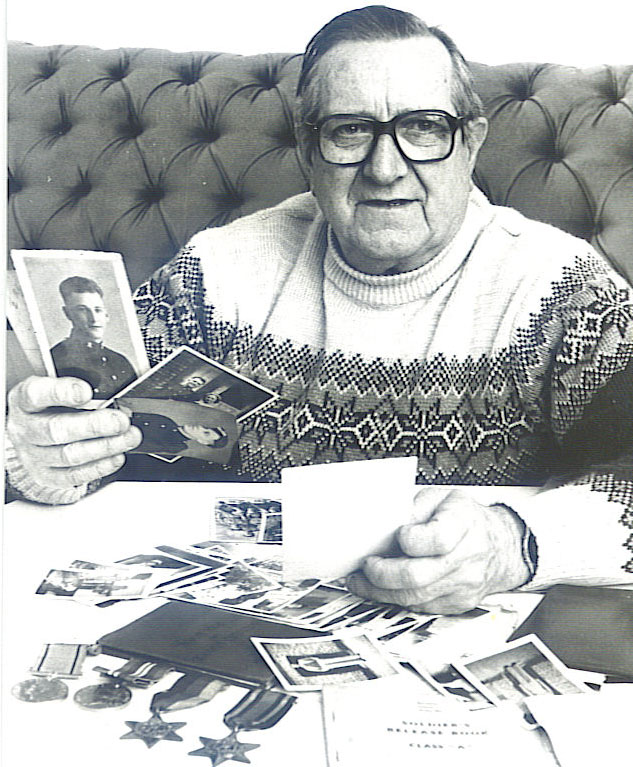
After so long in the captivity there were several problems for me, one being that I was so unaccustomed to female company that I had difficulty in their company, though two or three pints of beer helped to overcome this. I could be walking down the main street in York and a woman may come towards me in the opposite direction, I would stop and look in a shop window until she had gone past. Perhaps I should have gone to one of the rehabilitation centres towards getting accustomed to a much changed England from 1939/40 when I left.
Part Two
Chapter One
Having written these memoirs over a period of time, memories flooded back and I can now continue with a second part which may contain some repetition.
When we were in Calcutta Barracks, the black hole, we spent some time at Ronaldshay hut where there was entertainment for the troops. One of the chaps, nicknamed Tiddles, met a Eurasian girl and continued to see her thereafter. Generally he stayed overnight with her, returning to the barracks before reveille.
They used to go to the railway station and the train would draw out into the sidings until it was time to depart. They jumped on the train and stayed there until departure time. One night he overstayed and didn't return until after reveille. Consequently he was charged and given twenty-eight days' detention.
Following this we were all sent to Ranchi on training. When training was finished Tiddles wasn't returned with the rest of us because he was unfit due to his nocturnal activities! On our return to Calcutta we were marching along when Tiddles' girl approached me to ask where he was. As you can imagine she was frantic with anxiety.
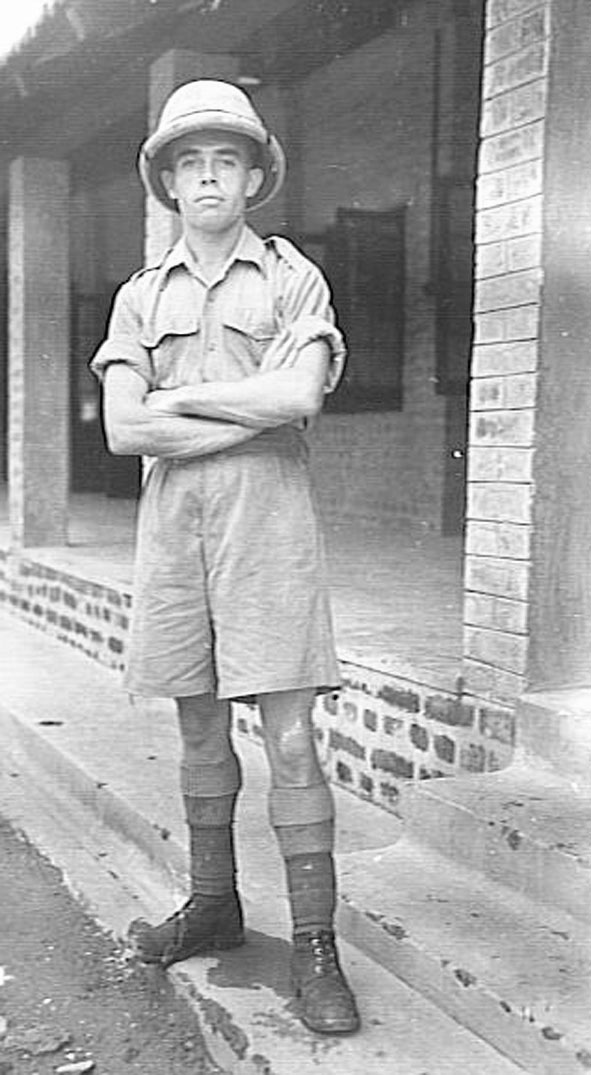
I was recommended for promotion to Lance Corporal and had to attend a training cadre at Ranchi. Each of us of a group of four was put in charge each day. When my turn came I was given a destination to head for, a map, a compass and three men.
We set off on the road and along came a civilian bus. I said to get on it which we did and set off. A little way along the road one of the chaps said "Here is the officers' jeep — get down", so we got down with the sheep and goats. The jeep got ahead and we settled down to a reasonably comfortable ride until we got to the point on the road opposite our destination.
It was a mile across country. We settled down there for a rest for quite some time and eventually made our way to the spot. We were met by a sergeant-in-charge and informed that a truck had got stuck in a river ford and we were to go on to free it. The people who had done the normal march had been better off than we had as they just settled down at the camp. I don't think my squad were very pleased with me as it had all gone wrong.
We sailed on a troop ship from India to Rangoon, landing at Rangoon docks in the middle of an air-raid. It was a good introduction to the war in Burma. There were no casualties and eventually we set off to Pegu. We marched from Rangoon to Pegu where there was no action on the ground but we were regaled by action in the air from the AVG's (American Volunteer Group) against the Jap Zeros.
The AVG's enjoyed great success bringing down several Jap planes with no casualties on their side. The AVG's were mercenaries and at the time had no backing at all from the British Air Force. The conflict was worth watching because of the success of the AVG's and we really enjoyed the spectacle.
As we marched into Pegu we came into heavy fog. Our platoon was positioned behind a low earth wall whereas the rest of the battalion were behind a taller bund to the rear of us. From the fog came the noise of metal being knocked into the ground, obviously a machine-gun, from only about fifteen to twenty yards in front of us only just visible.
I turned round to the corporal in charge that was senior to me, and suggested we would be better moving back. He agreed and gave the order to retire from the left, with each man alerting the next man as he passed him to move out. This was going alright until a chap came up to Tiddles, tried to alert him but reported him dead from a bullet in the back of his head. It must have been friendly fire from the bund.
During this action the other corporal said what a cheeky bugger this Jap was that had appeared five or six yards away from behind the haystack. I came down with my rifle and fired and didn't stay to see if I had hit him. After this we went behind the bund with the rest and from there commenced to retire to Rangoon which we had been told would be held at all costs.
We marched towards Rangoon on the railway meeting several hazards on the way, our troops having tried to deter the Japs from using the railway. On one occasion we came upon a bridge that had been set alight and partially destroyed. This we had to cross despite many sleepers being missing because of the fire. One of the chaps fell off the bridge onto his head causing considerable damage. He was bandaged up and continued to march with us. He was yet another hazard for us.
At this time we found out what it was to be like to be hungry and thirsty. As regards the thirst we stopped at a bullock wallow, shifted the bullocks and plunged our hats into the wallow. What came out of the eyelets in the hat we drank despite it being filthy, probably a contributory cause of later dysentery. A little later we called at a village and were offered food which was mainly rice on a banana leaf plus some minnows with eyes and tails attached. We refused, so maybe we hadn't found out what hunger was yet. Later on we were pleased to accept such an offer.
A little further on we realised we had to try to go north towards India. Having gone a certain distance we came upon a river. Many of us could not swim so we turned back and sheltered in a large hut. From here we could see a lot of Japanese, obviously camped up at a rubber plantation where we had camped previously some time ago. By this time most of our weapons were unusable because of rust etc.
The Japs sent out patrols and there was little we could do when they encountered us. Although we were uncertain that the Japs would take us prisoner, we were captured and taken along to the rubber plantation.
Part Two
Chapter Two
It was decided that the whole battalion would learn basic signaling such as morse code. This was done with a single flag which was held up with the hands being level with your nose. The sort of thing that was signaled was the word Constantinople or Mississippi (Monkey, ink, sugar, sugar, ink, sugar, sugar, ink, pip, pip, ink!). Invariably the signalers would go wrong at some stage, probably three quarters of a word and the squad was stopped with their hands held high and start again from the beginning. This would often go on two or three times before they all got it correct, everyone having to suffer from the odd one's mistake! Having been chosen as a private soldier to undertake the instruction it was embarrassing to have to keep correcting the officers.
There were a number of strange ailments from which we suffered such as ringworm which I previously mentioned affecting the water boiler ("Nogger"). He was covered from head to foot. Jungle sores which one could get from just a scratch which, when developed, would eat into the flesh and, in one case I remember, ate into a man's stomach so that one could see right inside his body.
The doctor did his best to heal these sores but the only medication that he had was copper sulphate, usually used on horse sores, found by a working party.
Many of the men suffered from 'weeping testicles' where blisters formed with severe itching, causing men to scratch and start weeping. The pain became unbearable and in one instance the man was so irritated by them that he resorted to the only medication available that was a solution of copper sulphate which he dabbed on his testicles. This medication acted like an acid and was unbearable. In the compound was a brick edifice holding a tap and water pipe. He dashed out there and put the tap full on trying to wash it off to ease the pain.
Another thing that affected a very large number was strongyloides. This was a type of worm which entered the soles of the feet as we were all bare-footed and entered the bloodstream, lodging itself behind the stomach wall where it stayed, later traveling via the bloodstream to all parts of the body causing extreme itching, worse than anything I have ever known, on its way.
I suffered from this for thirty years and my own G.P. informed me that it was probably urticaria which could be caused by food or nerves. As my diet did not alter it was assumed it was nerves. Consequently, I thought I had a nervous condition over many years.
Eventually I applied for a pension and received a copy of a medical report from the York Military Hospital where I was treated in 1945. This indicated that they had diagnosed strongyloides at that time but had not passed this on to the G.P., so no-one was aware of the condition until I attended the Tropical Diseases Hospital in Liverpool where this was diagnosed and treated effectively in less than a week!
The medical officer recommended that I receive a gratuity but this was turned down. Every now and again the 'family' that was resident outside the stomach wall decided to have a walk round my body causing extreme itching and discomfort. One day I bought some string vests which were all the vogue at the time. The strongyloides on their travels left my body covered with bumps which appeared at each hole of the string vest. I gave the vests away to my brother-in-law.
Another condition was nicknamed by us "Happy Feet" and in reading other accounts of different POW camps, this condition was noted by them as "Happy Feet" which I thought was rather strange. A good friend of mine suffered from this and, when we were released from Japanese control, when marching towards our own lines he was hanging on to me because his feet were in such bad condition that he could not bear his feet on the ground. The nerve endings in the soles of his feet caused them to jump continuously so that his feet were unable to stay on the ground.
A number of prisoners were brought in wearing green uniforms. These were Javanese troops from Dutch Java. Something was seriously wrong with them as from the start they were dying in numbers, loaded onto lorries and taken away to be buried. We never found out what was wrong with them but eventually all of them that remained were taken away. We never found out what had happened to them or where they went.
Prickly heat was suffered by many, being in two forms — dry and wet. Dry prickly heat was a severe itching caused by the sun, whereas wet prickly heat was a series of blisters which itched and caused severe discomfort.
Malaria was also common. It was caused by the mosquitoes, some cases being very serious. Many cases resulted in death, often preceded by nightmares.
A severe condition affecting most of the prisoners was dysentery. This, when it occurred with malaria, resulted in death. I have previously mentioned dysentery, affecting myself and another chap named Harry. As I described previously we were the worst cases I remember.
In an adjoining compound were Chinese POWs. Two of these started fighting and a Chinese general stepped between them to stop the fight. One of them stabbed him in the stomach. They elected to have our doctor operate on him. This he had to do in primitive conditions, using a scalpel found on a working party and sharpened on a cement step. Once again there was no anaesthetic and the general bravely underwent the operation, but unfortunately later died.
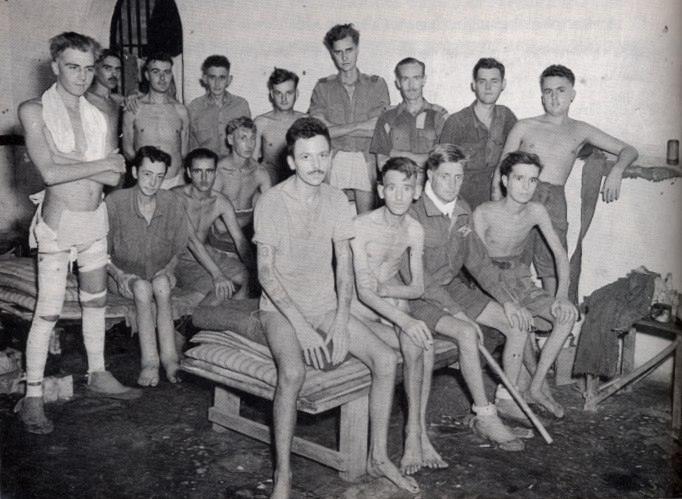
Another operation that was carried out was an amputation of a leg on a British POW. On this occasion ice was given as an anaesthetic. This prisoner survived.
One parasite we had to contend with was crab lice. These were small crab-like creatures which infested the skin. The claws embedded themselves with only a black spot showing. The treatment to eradicate them was to douse with methylated spirits or similar. Nothing like this was available in the prison camp which caused great difficulty.
Eventually, after having been incarcerated in the camp for a few weeks, the Japs told us that we would be going out on working parties in the future and would be paid the equivalent of one penny per day. I was in a working party of prisoners taken from the camp to clear a village area that had been bombed. The bodies were extricated from the rubble and it was most distressing when I pulled a body by the arm and the skin slid away right down to the wrist. This has caused me to have nightmares. We also unearthed a bed containing five adults.
On one occasion one of the men found some crystals which he brought back to the compound. These were copper sulphate known to us as bluestone. The doctor got quite excited about this and asked for the men to bring as much as possible. This is used to treat sores on horses and he intended to use it to treat the prisoners' sores.
We often went out on working parties in the heat of the midday sun. We were kept on the main road, marching in bare feet, with melting tar oozing between our toes. Eventually the soles of our feet were like leather. Later on when I had arrived home I was admitted to York Military Hospital. One morning the nurse turned back my sheet and found what she thought was a piece of leather. It was actually the sole of my foot which had become detached.
Also whilst on a working party, we were building blast walls around a hut to a height of about ten feet. At lunchtime we had to get down from the walls. I jumped and fell forward and impaled my hand on a rusty six-inch nail sticking up from a plank of wood. The Jap saw this, extricated the nail, went to a village hut and got a little cooking oil, pulled some hollow dried grass which he dipped in the oil, set alight and poured the burning oil into the hole made by the nail. I swore at him and it is the only time I was ever able to do this without retribution.
The Japs were making great efforts at concealment, clearing forests and building bamboo huts (bashas). On one occasion we had to clear a large plantation of pineapples — hundreds of them being jettisoned and wasted. Night after night we heard a bullfrog calling. One Yank was determined to get this for food and sat up for hours trying to catch it. I don't think he ever did. An officer got a papaya whilst out on a working party, saved and planted the seeds. Three of those grew to about ten feet in height in a short season. Only one of them bore fruit, this was the female. The male pollinated and the third was hermaphrodite with no purpose whatsoever. Unfortunately there was not enough fruit to supplement our diet.
The cook regularly made cake for the prisoners to eat, grinding rice between two grindstones to make flour. The flour was bound together with dubbin, an awful-smelling substance used for treating football boots. Cooking did at least reduce the awful taste and smell. The Japs decided they would like to try an English breakfast and approached our cooks to make it for them. The best they could do was to slice some pork thinly and fry it with eggs. The Japs finished off the preparation of the meal by smothering it in sugar! It was obvious that there was no shortage of sugar as they would half-fill their water bottles with sugar before filling them with water.
The Japs came and detailed off a party of our prisoners to do some work in the Chinese compound. When the job was completed the Chinese gave them some stew which the chaps found contained more meat than they had seen during all the time they were in the camp. Later a Jap came looking for his dog which had gone missing and remained so!
The diet of rice was often sweepings from the rice store floor, also containing rat droppings and broken glass.
Part Two
Chapter Three
The Japs employed a lot of coolies on some of the menial jobs and turned up with a printing machine on a lorry, printing the cash necessary to pay them out on the spot. The result of such actions caused a very high rate of inflation, examples of which were clothing, the price of which ruled the working population out of the market. Cheroots went up by one-hundred times at least.
There were two Aussies who had escaped from a Jap-held island attempting to row to India but landing up in the Rangoon river, were captured and joined us in the camp. It was amazing some of the things we did to amuse ourselves. One of them was to play the children's game of 'do or dare'. In playing this one of the Aussies who was about 6'3" in height had to stand on a stone edifice stark naked as a dare professing to be Eros.
The Japs decided to set up a sort of netball court. A party was organised to go to a local high school to bring back the netball posts which were constructed from a very heavy teak and had to be manhandled for the mile or so to the jail. When set up the Japs formed a team to play us. The only thing was that they had a different set of rules and their game was much like rugby whereas we were not allowed to tackle them.
We had to attend Tenko (roll-call) every day and we rapidly learned to count in Japanese as we had to call out, numbering in Japanese. One day a Scottish regiment were numbering and when it got to No. 7, which in Japanese is 'hichi', the Scot pronounced it 'hechi' which appeared to be the nearest he could get to the Japanese word because of his accent. The Japanese guard exploded, yelled bugaro at him (stupid) and knocked him about. The following day the same thing happened so an Englishman was drafted in to No. 7 to counter this.
On one working party a hefty Jap, proficient in martial arts, picked on an Irish prisoner who had recently lost his twin brother and commenced to throw him all over the place, not ceasing until lunchtime. After lunch he continued the treatment until the end of the working day. This was about ten hours in duration. When the young chap returned to the camp his mind had completely gone. For fear of what the Japs might do to him this was kept secret.
When he attended Tenko he was positioned in the back row and one day he broke ranks, went out to the camp commandant, shouting "I want a word with you" and his cover was blown. The Japs then put him in solitary confinement with a big Korean on guard. One day a meal of rice was handed in to him on a plate which he took to the tin used as a latrine, the contents of which he poured onto the plate. The Jap watched apparently expecting him to eat it standing at the bars of the gate. He received the contents in his face to his surprise.
Later, when the prisoners were released, he boarded the hospital ship taking the released prisoners to Calcutta and refused to get dressed — walking about everywhere naked. I doubt if he ever recovered his mind.
A most exacting task was performed in the wood yard shifting large lengths of teak to load onto lorries and taken to various workplaces. It was very heavy and dangerous work, taking all our strength to lift these onto our shoulders and having to drop them, jumping aside on either side of the teak beam. It required very good co-ordination. This was particularly difficult because of our lack of bodily strength as our average weight was six stone.
We went out on a working party at some distance away and were transported by a short-sided lorry; the party filling the lorry standing and holding on to each other to remain on the lorry. After a day's work we returned in the lorry still clinging on to each other except that one man had ceased to hold on and was flung into the path of a following vehicle which ran over him. Recognition was impossible but he was identified by a distinctive cap that he wore. On return to the camp we were greeted by the chap who had loaned his hat to the deceased prisoner!
The officers in the camp had a particularly bad beating up from the Japs, for some unknown reason, ending with them being ordered to face each other and beat each other up. On one occasion, after the bombers had been over and killed the guard, one officer made a comment that yesterday's bombing was very, very good to a Japanese corporal whose best friend had been killed in that bombing. For some weeks after, the corporal came and asked for the captain to be brought to him, stood him to attention and slapped him repeatedly.
Part Two
Chapter Four
Near the entrance to the jail was a line of single cells, used when the jail was occupied by civilian prisoners as condemned cells. At one end of these was the gallows. In some of these the Japs set what we called a candle factory where some of our prisoners were employed making candles for use in the field for cooking purposes. In another cell were the only woman prisoner and her children. She was a British lady who I understand later returned home and wrote a book. In another cell was a Russian who we nicknamed Joe after Stalin. He had a luxuriant beard and one day, having got a razor from somewhere, he decided to shave it off. He had shaved half of his face when a Jap burst in, took his razor from him, leaving him with half a beard and half shaven.
The Japs decided to have a brass band concert which we were all ordered to attend. We had to show appreciation by clapping after each item despite being bored stiff. One of the tunes was quite catchy and a prisoner put our own words to it which we sang on the march. The Japanese were quite pleased though they would not have been if they had realised what words we were singing.
The Japanese wine was sake, distilled from rice. This was exceptionally strong, as I found to my cost when the Japs of the mechanics party, with whom we were working, brought in a few bottles. This was passed round our men and I was given a small bottle to myself. Not having had alcohol for some years I really felt the effects! I felt as if I was drinking from a square bottle, a similar effect to having an anaesthetic for a tooth extraction.
Whilst I was with the mechanics party we got a weekly treat of sweet Indian tea with a Japanese sweetmeat of a special rice containing a sweet paste similar to an Eccles cake, the nearest I can describe it. Not something I would relish here but there it was a delicacy. I had another introduction to the small minnow-like fish as this time, a trench had been dug round the hut where we worked and this had filled with water, miraculously also filled with these fish. A little Jap caught them, speared on wire, cooked them over an open fire and proceeded to eat them, offering them to us. On this occasion, instead of rejecting them as previously, we welcomed the offer.
Near the tyre repair hut where we worked was a small Pakistani village. Occasionally we met up with a Pakistani from the village, usually when we were having a bath at the well in the jungle. He took a great risk in bringing us a little food. Had it been possible, when the Japs were defeated, I would have liked to reward this chap for what he had done for us.
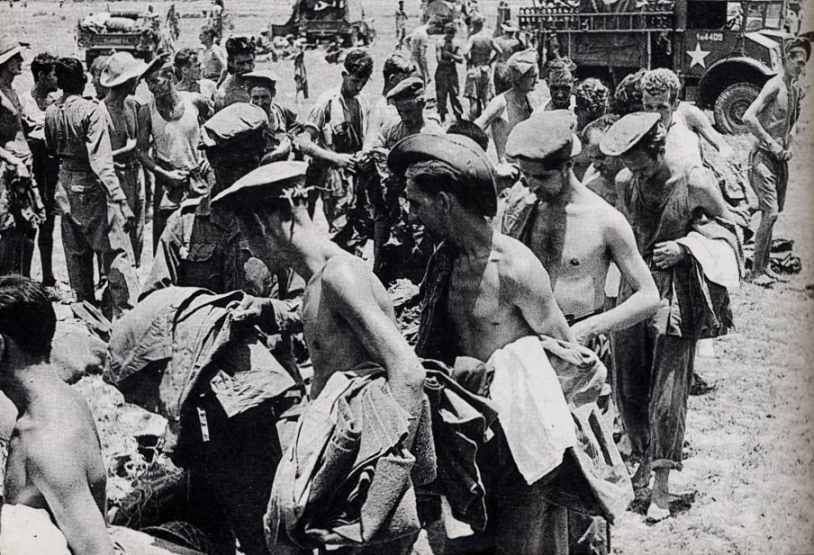
We were eventually freed on the 29th April 1945, the day before my father's birthday. One of my memories of that day was that the cook of the West Yorkshire Regiment brewed Indian tea laced with whisky — a very welcome drink. We were obviously short of decent clothing and members of the battalion gave us some of their own kit to tide us over. Later on I met up with one of these young soldiers who informed me that they had been charged for the replacement of this clothing by the regiment!
Part Three
When we arrived back in England we were de-briefed, along with prisoners from other theatres of war. Our interviews were noticeably short, whereas it was noted that prisoners freed by the Russians were interviewed at length, being asked how they had been treated. It seemed to us that more trouble was expected with the Russians. Eventually this became a long-term Cold War.
During the interview I was asked if I wished to claim compensation for any personal items taken by the Japanese. There were three presents I had received in England five or more years ago — a signet ring, a good fountain pen and a cigarette case. I claimed ten pounds to replace these items and later received five pounds, which they said was the limit unless I could produce receipts. Did this mean receipts from the Japanese captors or the original receipts from over five years ago?
I was the first ex-Jap POW home in York, about three weeks before Tom. We eventually met up in York after repatriation. Walking out one day we passed a restaurant where a notice was displayed regarding a meeting being held at that time of relatives of Jap POWs. We decided to attend in case we could help with information which may have relieved their worries.
We approached the organiser of the meeting who asked us if we would give a talk on the platform. We declined because we were both still nervous and uncomfortable in the presence of large groups. We suggested that we sat at the back of the hall and if anyone wanted to talk to us they could do so there. One mother came with her daughter and we discussed her son. We tempered the truth a little to save their feelings. A week or two later we went into a pub in York and the daughter was having a quiet drink with her brother. He was certainly not a skinny little chap as we had been, obviously built up in India before returning home. He was, however, dead within weeks, possibly unable to re-adjust.
The battalion's paymaster was housed in the Rowntree's chocolate factory in York. Tom and I went there to collect some pay. My name was requested which I gave as Troughton, Corporal. They informed me that they only had a Private Troughton listed and that I had been demoted according to the rules after six weeks back in England having been a prisoner of war!
During the three years or so of captivity I received no pay. This accumulated over the period and eventually after release I was paid out. The tax man stepped in and, though I would not have paid any tax had I been paid at the proper time, tax was deducted for the whole period, hardly a thank you for serving the country. Having enquired about this all I was told was that it was lucky I was married or I would have paid a lot more.
Four of us who had been prisoners met fairly regularly to have a quiet drink. On one occasion we went into the lounge bar of a pub where the only other person was a little old lady drinking a half of Guinness. We sat down chatting for a while and eventually the subject turned to life in the jail. At this point the lady got up hurriedly having supped her drink and we said "What's that about?" Afterwards it dawned on us why she had left in such a hurry. She had obviously taken us for criminals out from prison.
There was a shortage of beer as well as everything else. As a consequence pubs were opening for a short time and then closing. We would have to go off to find another pub with different hours. We caught on eventually and each of the four of us would order four pints so we had sixteen pints of beer on the table! Very early on I walked into a pub, ordered a pint and twenty cigarettes for which I tendered 2/6d and waited for the change. I got a surprise when I was asked for more cash; both of these items had gone up considerably during my imprisonment.
We would go for a pint of beer in York, spend a couple of hours in the pub then go out to the fish and chip shop, have a meal then go back to the pub for more drink. Later we would go home for supper! We did not seem to be able to satisfy our appetites. In later years I saw this happening again with the displaced persons who came to this country after being forced to work for the Germans.
The four of us attended a function at the drill hall in York where Field Marshall Slim came along the ranks talking to everyone and in our case discussing what we had been through in Burma. One of the lads said that they had been a long time in getting down to us and Slim's reply was that they had eventually caught and hanged the Japanese camp commandant.
Before recruitment into the forces I was engaged to be married to a young lady in York. Including my service in India I was away from England for just over five years. This girl visited my family and waited for almost five years for my return despite not knowing if I was alive or not, the only notification from the War Office being "missing". On my return home my mother informed me that she had married only three months before.
Two or three months after my return I met a young WAAF. Eventually I introduced Tom to her friend and we went out together as a foursome. I got married a few months later and Tom was our best man.
The reception was held at a cafe which had been bought for another ex-POW from Rangoon by an officer who had been looked after by this chap whilst in the camp.
Later on Tom married and I was his best man. Although having known Tom from being very young, and all through our captivity, we drifted apart, mainly because of distance, but I miss him since his death two or three years ago. Another friend, Harry, also mentioned in the book, also died last year. I seem to be the only one left of those that were resident in the York area.
My wife and I soon had a child, a girl, and went along to the local church for the christening. There on the wall was a Roll of Honour with my name included. We notified them and had it erased!
My second wife, Lorna, and I went on holiday to a hotel abroad and went into the restaurant for a meal. As I sat there I saw three Japs in single file coming into the restaurant. My reaction was such that Lorna made me change places with her so that I had my back to them. After about 30 years I still couldn't stand the sight of the Japanese.
From about twelve years ago I have attended a Combat Stress home for rehabilitation two or three times a year for two weeks at a time. They have done wonders for me with various sessions of counselling and therapy with the carers. Relaxation sessions have really helped me. They also encouraged me to write about my experiences which have become this book.
Another group that I have been involved with was the Not Forgotten Society who took me on outings including trips on the canal and a visit to Buckingham Palace for the Queen's Garden Party.