Chapter Thirteen
The Hospital and the Condemned Cells
The hospital cell was busy from the day it opened. Beriberi filled it, bred of the rice diet; dysentery was everywhere, though it did not always need a bed; and there was malaria. One man seemed to have no grave illness at all, yet faded and died calling for his wife — heartbreak, as near as any of us could tell. Another died struggling to work the rings off his fingers. A man from Leeds lay for weeks on his back, his legs forced apart, unable to close them because beriberi had swollen his testicles nearly to the size of a football; a civilian doctor from the Andaman Islands, imprisoned with us, drained the fluid off and kept him going, until the doctor and his fellows were moved elsewhere in Burma, and the man died for want of him. But another, left unable to walk by beriberi, hauled himself upright on the wooden bars of the cell and forced his legs to work, week after week, until he could take a few steps, and then a few more, mending all the time. In a place like that, such a thing was a kind of victory.
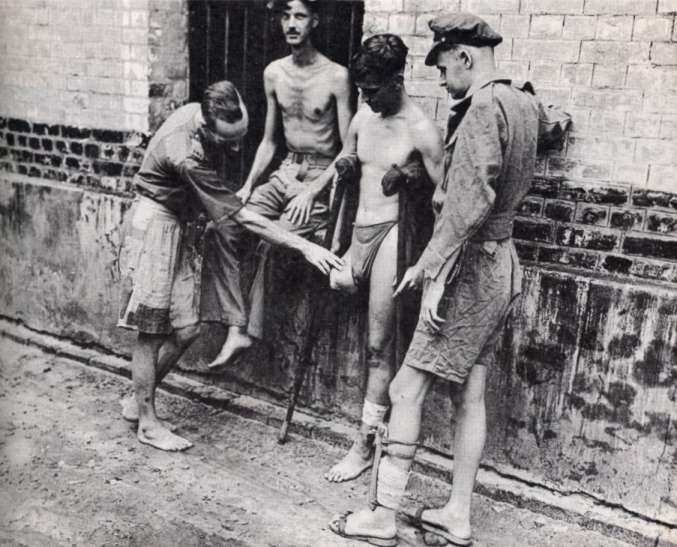
Not all the suffering was the work of disease. One Sunday the Japanese made us file past two of their men at a table with pens and paper. Tom was ahead of me, and when they saw his number they waved him away; suspecting something, I slipped off to the toilets. About thirty men were chosen, and it came out later that they were to be guinea-pigs in an attempt to isolate the dengue germ — Tom had been turned away because he had already done it once before, with another of our pals. The chosen men were taken to a separate block, infected, and then given far better treatment than the rest of us: superior rations, mosquito nets, blankets. They were kept on it a long time, and when at last they came back to us and to the old poor diet, many could not cope with the change, fell ill, and died.
Near the entrance stood a line of single cells, the condemned cells of the old civilian jail, with the gallows at one end. In some of them the Japanese set up what we called the candle factory, where prisoners made candles for cooking in the field. In another lived the only woman prisoner and her children — a British lady who, I understand, went home afterwards and wrote a book. And in another was a Russian we nicknamed Joe, after Stalin, who wore a magnificent beard until the day he got hold of a razor and set about shaving it off; he had done one half of his face when a guard burst in and took the razor, and left him so — half-bearded, half-shaved.
Contents · Switch to Bill's manuscript