Part Two
Chapter Two
It was decided that the whole battalion would learn basic signaling such as morse code. This was done with a single flag which was held up with the hands being level with your nose. The sort of thing that was signaled was the word Constantinople or Mississippi (Monkey, ink, sugar, sugar, ink, sugar, sugar, ink, pip, pip, ink!). Invariably the signalers would go wrong at some stage, probably three quarters of a word and the squad was stopped with their hands held high and start again from the beginning. This would often go on two or three times before they all got it correct, everyone having to suffer from the odd one's mistake! Having been chosen as a private soldier to undertake the instruction it was embarrassing to have to keep correcting the officers.
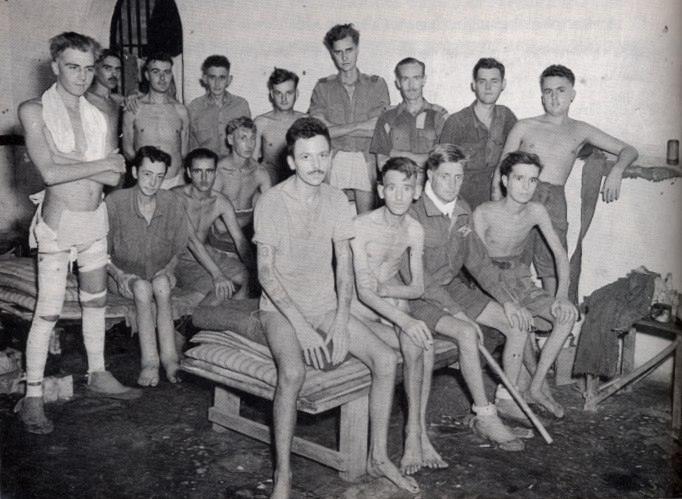
There were a number of strange ailments from which we suffered such as ringworm which I previously mentioned affecting the water boiler ("Nogger"). He was covered from head to foot. Jungle sores which one could get from just a scratch which, when developed, would eat into the flesh and, in one case I remember, ate into a man's stomach so that one could see right inside his body.
The doctor did his best to heal these sores but the only medication that he had was copper sulphate, usually used on horse sores, found by a working party.
Many of the men suffered from 'weeping testicles' where blisters formed with severe itching, causing men to scratch and start weeping. The pain became unbearable and in one instance the man was so irritated by them that he resorted to the only medication available that was a solution of copper sulphate which he dabbed on his testicles. This medication acted like an acid and was unbearable. In the compound was a brick edifice holding a tap and water pipe. He dashed out there and put the tap full on trying to wash it off to ease the pain.
Another thing that affected a very large number was strongyloides. This was a type of worm which entered the soles of the feet as we were all bare-footed and entered the bloodstream, lodging itself behind the stomach wall where it stayed, later traveling via the bloodstream to all parts of the body causing extreme itching, worse than anything I have ever known, on its way.
I suffered from this for thirty years and my own G.P. informed me that it was probably urticaria which could be caused by food or nerves. As my diet did not alter it was assumed it was nerves. Consequently, I thought I had a nervous condition over many years.
Eventually I applied for a pension and received a copy of a medical report from the York Military Hospital where I was treated in 1945. This indicated that they had diagnosed strongyloides at that time but had not passed this on to the G.P., so no-one was aware of the condition until I attended the Tropical Diseases Hospital in Liverpool where this was diagnosed and treated effectively in less than a week!
The medical officer recommended that I receive a gratuity but this was turned down. Every now and again the 'family' that was resident outside the stomach wall decided to have a walk round my body causing extreme itching and discomfort. One day I bought some string vests which were all the vogue at the time. The strongyloides on their travels left my body covered with bumps which appeared at each hole of the string vest. I gave the vests away to my brother-in-law.
Another condition was nicknamed by us "Happy Feet" and in reading other accounts of different POW camps, this condition was noted by them as "Happy Feet" which I thought was rather strange. A good friend of mine suffered from this and, when we were released from Japanese control, when marching towards our own lines he was hanging on to me because his feet were in such bad condition that he could not bear his feet on the ground. The nerve endings in the soles of his feet caused them to jump continuously so that his feet were unable to stay on the ground.
A number of prisoners were brought in wearing green uniforms. These were Javanese troops from Dutch Java. Something was seriously wrong with them as from the start they were dying in numbers, loaded onto lorries and taken away to be buried. We never found out what was wrong with them but eventually all of them that remained were taken away. We never found out what had happened to them or where they went.
Prickly heat was suffered by many, being in two forms — dry and wet. Dry prickly heat was a severe itching caused by the sun, whereas wet prickly heat was a series of blisters which itched and caused severe discomfort.
Malaria was also common. It was caused by the mosquitoes, some cases being very serious. Many cases resulted in death, often preceded by nightmares.
A severe condition affecting most of the prisoners was dysentery. This, when it occurred with malaria, resulted in death. I have previously mentioned dysentery, affecting myself and another chap named Harry. As I described previously we were the worst cases I remember.
In an adjoining compound were Chinese POWs. Two of these started fighting and a Chinese general stepped between them to stop the fight. One of them stabbed him in the stomach. They elected to have our doctor operate on him. This he had to do in primitive conditions, using a scalpel found on a working party and sharpened on a cement step. Once again there was no anaesthetic and the general bravely underwent the operation, but unfortunately later died.
Another operation that was carried out was an amputation of a leg on a British POW. On this occasion ice was given as an anaesthetic. This prisoner survived.
One parasite we had to contend with was crab lice. These were small crab-like creatures which infested the skin. The claws embedded themselves with only a black spot showing. The treatment to eradicate them was to douse with methylated spirits or similar. Nothing like this was available in the prison camp which caused great difficulty.
Eventually, after having been incarcerated in the camp for a few weeks, the Japs told us that we would be going out on working parties in the future and would be paid the equivalent of one penny per day. I was in a working party of prisoners taken from the camp to clear a village area that had been bombed. The bodies were extricated from the rubble and it was most distressing when I pulled a body by the arm and the skin slid away right down to the wrist. This has caused me to have nightmares. We also unearthed a bed containing five adults.
On one occasion one of the men found some crystals which he brought back to the compound. These were copper sulphate known to us as bluestone. The doctor got quite excited about this and asked for the men to bring as much as possible. This is used to treat sores on horses and he intended to use it to treat the prisoners' sores.
We often went out on working parties in the heat of the midday sun. We were kept on the main road, marching in bare feet, with melting tar oozing between our toes. Eventually the soles of our feet were like leather. Later on when I had arrived home I was admitted to York Military Hospital. One morning the nurse turned back my sheet and found what she thought was a piece of leather. It was actually the sole of my foot which had become detached.
Also whilst on a working party, we were building blast walls around a hut to a height of about ten feet. At lunchtime we had to get down from the walls. I jumped and fell forward and impaled my hand on a rusty six-inch nail sticking up from a plank of wood. The Jap saw this, extricated the nail, went to a village hut and got a little cooking oil, pulled some hollow dried grass which he dipped in the oil, set alight and poured the burning oil into the hole made by the nail. I swore at him and it is the only time I was ever able to do this without retribution.
The Japs were making great efforts at concealment, clearing forests and building bamboo huts (bashas). On one occasion we had to clear a large plantation of pineapples — hundreds of them being jettisoned and wasted. Night after night we heard a bullfrog calling. One Yank was determined to get this for food and sat up for hours trying to catch it. I don't think he ever did. An officer got a papaya whilst out on a working party, saved and planted the seeds. Three of those grew to about ten feet in height in a short season. Only one of them bore fruit, this was the female. The male pollinated and the third was hermaphrodite with no purpose whatsoever. Unfortunately there was not enough fruit to supplement our diet.
The cook regularly made cake for the prisoners to eat, grinding rice between two grindstones to make flour. The flour was bound together with dubbin, an awful-smelling substance used for treating football boots. Cooking did at least reduce the awful taste and smell. The Japs decided they would like to try an English breakfast and approached our cooks to make it for them. The best they could do was to slice some pork thinly and fry it with eggs. The Japs finished off the preparation of the meal by smothering it in sugar! It was obvious that there was no shortage of sugar as they would half-fill their water bottles with sugar before filling them with water.
The Japs came and detailed off a party of our prisoners to do some work in the Chinese compound. When the job was completed the Chinese gave them some stew which the chaps found contained more meat than they had seen during all the time they were in the camp. Later a Jap came looking for his dog which had gone missing and remained so!
The diet of rice was often sweepings from the rice store floor, also containing rat droppings and broken glass.
Contents · Switch to Reading Edition