Part Two
Chapter Four
Near the entrance to the jail was a line of single cells, used when the jail was occupied by civilian prisoners as condemned cells. At one end of these was the gallows. In some of these the Japs set what we called a candle factory where some of our prisoners were employed making candles for use in the field for cooking purposes. In another cell were the only woman prisoner and her children. She was a British lady who I understand later returned home and wrote a book. In another cell was a Russian who we nicknamed Joe after Stalin. He had a luxuriant beard and one day, having got a razor from somewhere, he decided to shave it off. He had shaved half of his face when a Jap burst in, took his razor from him, leaving him with half a beard and half shaven.
The Japs decided to have a brass band concert which we were all ordered to attend. We had to show appreciation by clapping after each item despite being bored stiff. One of the tunes was quite catchy and a prisoner put our own words to it which we sang on the march. The Japanese were quite pleased though they would not have been if they had realised what words we were singing.
The Japanese wine was sake, distilled from rice. This was exceptionally strong, as I found to my cost when the Japs of the mechanics party, with whom we were working, brought in a few bottles. This was passed round our men and I was given a small bottle to myself. Not having had alcohol for some years I really felt the effects! I felt as if I was drinking from a square bottle, a similar effect to having an anaesthetic for a tooth extraction.
Whilst I was with the mechanics party we got a weekly treat of sweet Indian tea with a Japanese sweetmeat of a special rice containing a sweet paste similar to an Eccles cake, the nearest I can describe it. Not something I would relish here but there it was a delicacy. I had another introduction to the small minnow-like fish as this time, a trench had been dug round the hut where we worked and this had filled with water, miraculously also filled with these fish. A little Jap caught them, speared on wire, cooked them over an open fire and proceeded to eat them, offering them to us. On this occasion, instead of rejecting them as previously, we welcomed the offer.
Near the tyre repair hut where we worked was a small Pakistani village. Occasionally we met up with a Pakistani from the village, usually when we were having a bath at the well in the jungle. He took a great risk in bringing us a little food. Had it been possible, when the Japs were defeated, I would have liked to reward this chap for what he had done for us.
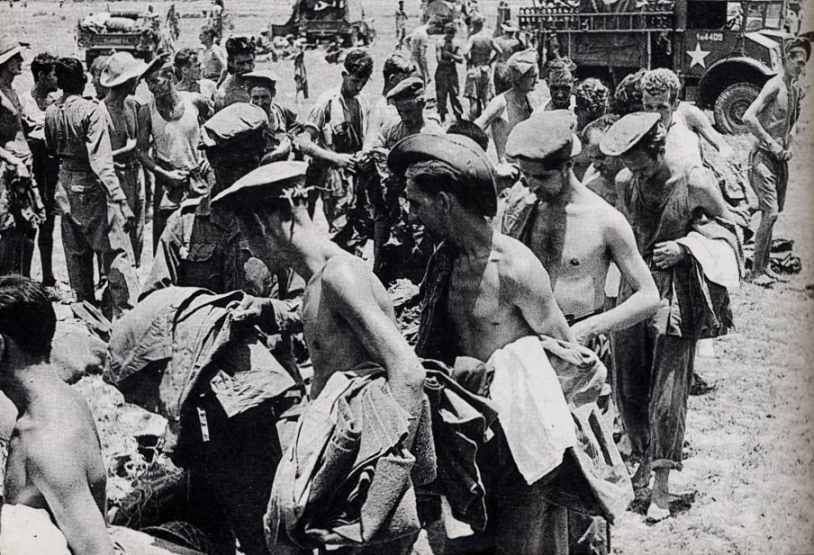
We were eventually freed on the 29th April 1945, the day before my father's birthday. One of my memories of that day was that the cook of the West Yorkshire Regiment brewed Indian tea laced with whisky — a very welcome drink. We were obviously short of decent clothing and members of the battalion gave us some of their own kit to tide us over. Later on I met up with one of these young soldiers who informed me that they had been charged for the replacement of this clothing by the regiment!
Contents · Switch to Reading Edition