Part One
Chapter Two
We were taken prisoner and marched to a large house some miles towards Rangoon and allocated spaces for sleeping with a restricted area for daytime use. After about two days, a small party of men, including Tom, was sent into Rangoon for rations of rice and dried potatoes. A couple of men were given the job of cooks, of which they claimed they had experience. The only utensil they had was a metal bath tin which they filled with rice and water and placed over the open fire to boil. The amount of water used was at best about a quarter of what was necessary and the result was a mass of burnt, uncooked rice to be consumed over the next three or four days.
After a few days we were told we were to go to a big house in Rangoon and we set off in the march there. Eventually we were passing the prison which Tom informed everyone was now a ration store which we would pass to get to the "Big House". He was totally wrong as the "Big House" was actually the prison where we halted outside the gates, were searched and moved inside. There we halted, emptied out our pockets and whatever containers we had for the Japs to appropriate any items they thought we should not have. These included knives, forks and needles from our "Housewives" all of which they said could be used as weapons.
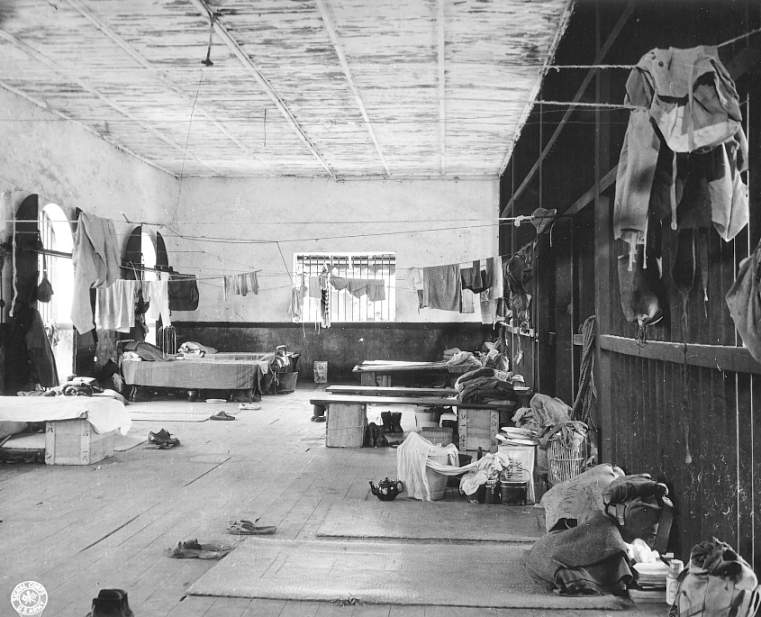
The cells were made to accommodate twenty civilian prisoners in blocks of five cells with six blocks stemming from a hub which was a water tower. We were marched to No. 3 block which we entered and found playing cards scattered all over the floors. We gathered them up willy-nilly to sort them into packs later. These were our only source of entertainment for quite a time as we were confined to the cell, about thirty plus instead of twenty as intended. Some had a wooden slatted bed with a wooden pillow, others slept on the floor. The beds were riddled with bugs so I don't know who was better off. The beds were fixed in the floor but eventually we freed them so we could move them out into the sun, which caused the bugs to leave the beds to try to get back to the buildings, usually to perish on the way. Time passed slowly with nothing to fill the hours except for playing cards in groups and sharing a cigarette made by rolling cheroot tobacco in newspaper or whatever paper we could obtain.
The Japanese flag used to be a red semi-circle with rays on a white background. This was changed to a full red circle on a white background without the rays. These we named the red chapatti. We did this as an insult to the Japanese, and the nickname is also that for this book.
Contents · Switch to Reading Edition